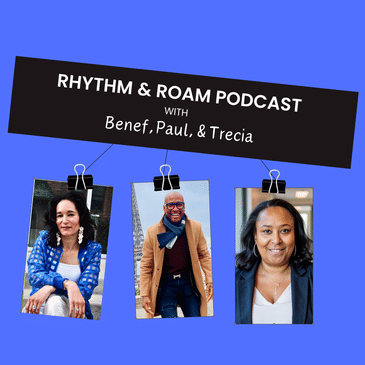



Benef, Paul, and Trecia host special guest Roya Fox, IG, Tikok, and YouTube digital creator, who describes the life-changing cultural exchanges that inspired her love of travel. The trio explore personal travel stories, share what fuels the obsession with adventure, and discuss how connecting with locals makes each trip more meaningful. Tune in, and let’s break down the thrill, frustrations, and joys that make travel addictive. Visit Roya Fox on IG, TikTok, or YouTube @royaventurera.
[00:00:00] I think like day to day life there's little challenges that you encounter if you live abroad like where is the milk in the grocery store? Like the thing that you never thought was going to be a question. I just remember thinking like, oh maybe this grocery store doesn't sell milk which is like, of course they have milk.
[00:00:22] Everything I've met with Roya was through social media, specifically on IG because everything she does was hilariously funny and hilariously true. Specifically because I live here in Paris and I can relate as an American living in Paris. And I cannot stop laughing and I have to say your videos make my day when I come from work or just during the day and I truly mean that kind of thing.
[00:00:49] But I really do want to jump into this a little bit Roya and maybe jump in with a couple of quick icebreaker things off the top of your head that you can answer and would be curious to hear your, you know, so we can get to know you a bit better.
[00:01:03] If you could have dinner with any fictional character, who would it be and why?
[00:01:09] Oh my gosh, this is a big question.
[00:01:13] I mean, there are, I feel like there are so many different like fandoms that I'm a part of.
[00:01:18] Like the immediate one is like, I feel like it's so classic, but like definitely like Hermione Granger and Harry Potter. I grew up on Harry Potter.
[00:01:31] Yeah.
[00:01:32] All of the books.
[00:01:33] Like, I don't know. So, and I always like really identified with Hermione.
[00:01:40] I've even had dreams where I was like playing a different character of Harry Potter in my dream.
[00:01:45] No way!
[00:01:46] I really love Harry Potter dreams.
[00:01:47] I could do that. Definitely Harry Potter.
[00:01:50] Yeah, I would love to be like in the Hogwarts.
[00:01:55] Yeah, and I want them to just like teach me their ways. Hopefully I'm not a muggle or something.
[00:02:00] Yeah, I read, I read all of them. I was like even at, I remember when the seventh book came out.
[00:02:05] I went to like the opening night party at Barnes and Noble.
[00:02:10] And I mean, I was really young. I think I was like, I was in middle school or something.
[00:02:14] But it was like a big deal that my parents let me go with some of my friends and we were like there at midnight when the book came out.
[00:02:21] Wow. If you could have any superpower, what would it be and why?
[00:02:29] Between like flying and invisibility as a superpower, I always choose invisibility.
[00:02:35] Because like some people are like, oh, but you love to travel.
[00:02:38] Wouldn't you want to like fly?
[00:02:39] And I'm like, yes, but I can just like sneak onto an airplane if I'm invisible.
[00:02:44] Oh!
[00:02:46] Invisible!
[00:02:47] Or that was my thing.
[00:02:49] I was like, I'll have the best of both worlds.
[00:02:51] I don't need to fly outside. I can still fly.
[00:02:54] That is true. That is true.
[00:02:56] I always like that one.
[00:02:59] So my name is Roya and as a content creator, it is Roya Aventurera.
[00:03:05] And for those of you who don't know what that means, I actually created this username like when I was in college because it was really trendy to have like your name kind of blend into a word.
[00:03:15] And I had just come back from living in Spain and I was studying Spanish in college and my minor was actually in Hispanic studies.
[00:03:24] And so I really liked the word Aventurera, which is like an adventurous.
[00:03:29] And I feel like I'm an adventurous person.
[00:03:31] I'm an adventurer, as we might say.
[00:03:33] And so that's where my username comes from.
[00:03:38] And then on as a content creator, I like to make skits.
[00:03:43] I like to talk about languages and travel.
[00:03:46] And really, for me, it's a place to just share what I am passionate about, share the things that I find most interesting and fun.
[00:03:56] And, you know, I'm so thrilled to have so many people connect with some of these things.
[00:04:04] Like it makes me feel like I have this community in a way that relates to some of my experiences where like, you know, in my day to day life, I have lots of friends who are interested in travel and stuff like that.
[00:04:15] You know, I live in Washington, D.C. And so, you know, I have a big range and a mix of friends and like most of them aren't multilingual, too.
[00:04:26] And most haven't lived abroad like I have.
[00:04:28] So although it's stuff that I talk to about my friends, like it's nice to feel like I'm connecting to people who, you know, see my videos, who have had these experiences abroad.
[00:04:39] Absolutely.
[00:04:41] And that just that feels really nice, like to be able to people and express myself creatively that way.
[00:04:48] I watched just recently a video where you were talking about like the trying to get it was an Emily in Paris, trying to get an apartment, but you don't have an address, need a bank account, but you don't have an address.
[00:05:02] And it was like this do loop. And Paul, I was like, when you first moved there, that was he was complaining about this do loop.
[00:05:09] He was stuck in with the address, but needing a bank account, but not having an address.
[00:05:14] Nobody could tell me the right answer either. And I was.
[00:05:17] Yeah, I know it's so it's so so tough.
[00:05:21] Even my French friends who like are born and raised in France, like trouble finding apartments.
[00:05:27] And it's such a process, like one of my best friends, she lived in Paris, she was having big bed bug issues.
[00:05:35] Like, remember when the big.
[00:05:36] Yes, I remember. Right before the Olympics.
[00:05:39] Oh, like national news.
[00:05:41] She had repeated bed bugs and she was like, I just need to like move like they had to do all these extermination things.
[00:05:47] And even just trying to find an apartment to get away from the bed bug situation.
[00:05:52] I had done extermination after extermination and gotten rid of stuff and all of this was like such a challenge.
[00:05:59] And like, partly I made that skit thinking about what she had gone through and like how difficult it was to find an apartment.
[00:06:06] And like in my own experience, I was actually really lucky because this same friend actually that I'm talking about, she was my roommate when I lived in Nantes in France.
[00:06:17] And I was really lucky because her parents helped me through all of that.
[00:06:22] So if I didn't.
[00:06:23] Oh, wow. OK.
[00:06:24] It would have been so much harder.
[00:06:26] So like they let me use their address.
[00:06:28] But like I have a French family, a French person to like be able to sign and give me their address and have access to all of these things.
[00:06:38] And so I just recognize how fortunate I have her family there for me when I was first moving to Nantes.
[00:06:47] I mean, what did you end up doing, Paul?
[00:06:48] Like, was it like a business colleague that gave you their address?
[00:06:52] I basically my agent who was helping me to find a place we went to my bank.
[00:06:57] The bank was like, oh, you can't you need an address.
[00:06:59] So bottom line is we're like we tried and they can't.
[00:07:02] They're like, well, the law says this.
[00:07:04] I was like, well, the law is not talking to each other.
[00:07:06] And then we just basically just did something illegal.
[00:07:10] My agent just gave her address, her address, somebody somebody's address.
[00:07:14] Yeah. Yeah.
[00:07:15] Which I was like, this is like anybody going to talk to the government and say that this doesn't work.
[00:07:21] That's right.
[00:07:23] Well, so what inspired you to travel in the first place?
[00:07:28] And because you keep traveling, you continue to travel.
[00:07:31] So what was your like initial inspiration?
[00:07:34] So I really think even as like a small child, it was always my dream to travel.
[00:07:41] And there are two main reasons for that.
[00:07:43] One, my family was a host family for exchange students for the local college in the city that I grew up in.
[00:07:50] And so or it's a college now, but it was a community college.
[00:07:54] So the community college would have students and then we signed up to be one of the families to have them live with us.
[00:08:01] And so this really I think my parents started doing that shortly after I was born or maybe even before I was born.
[00:08:08] So I always through the end of through the end of elementary school, there were always students from other countries living in my home with me.
[00:08:19] And so I think, yeah, it was like it was such a great experience and it was so cool.
[00:08:25] And actually, the majority of the students who lived with our family were from Japan.
[00:08:28] And so I grew up with Japanese culture and Japanese language in my household.
[00:08:35] And fun fact about me, even though I'm most known for France and French content, the first language besides English that I learned was actually Japanese.
[00:08:44] Oh, wow.
[00:08:45] Wow.
[00:08:46] So I are a woman of everything.
[00:08:49] I don't I don't claim that I speak Japanese now, though, like, I really never learned it enough to be communicative that much.
[00:08:58] And like so much of the first few years of learning Japanese is learning the writing system.
[00:09:03] And when you learn a language that uses the Roman alphabet similar to English, you kind of, you know, you can skip that part and just start learning grammar and vocabulary.
[00:09:14] And so, yeah, I did actually take three years of Japanese in elementary school.
[00:09:18] Oh, wow.
[00:09:20] And I took Japanese again in college to try to get back to it.
[00:09:25] But but I mean, it was a really, really hard course.
[00:09:28] And so there's I still know some words and some like some of the characters, but like I never claimed that I speak.
[00:09:37] Yeah, no, it's not an easy language.
[00:09:39] And in the fact that like I did.
[00:09:42] And and I mean, because like you have to memorize the characters along with the right.
[00:09:46] I'm your Ghana and Katakana, but like they're still learning to read characters in high school, which seems so crazy to me, because once you know the alphabet that you can read any of the words in the English language.
[00:10:00] But is it not vast?
[00:10:01] I mean, is it just isn't it, you know, a language as a whole when you're when you're reading it or when you're trying to learn the letters?
[00:10:08] Isn't it a vast library of of content?
[00:10:12] Well, so but they're not letters, they're they're characters.
[00:10:15] Oh, well, yeah, concepts or okay.
[00:10:19] Yeah.
[00:10:19] So you have to memorize what it looks like.
[00:10:22] And I don't know.
[00:10:23] I thought and I have this like memory, too, from when I was kid, actually, and you know, I must have been like five or six.
[00:10:32] And we had done the alphabet in school and all of that.
[00:10:35] And like, you know, doing reading and writing in class.
[00:10:38] And I remember going to one of the Japanese students who was living us with us at the time.
[00:10:43] And I said, can you teach me the Japanese alphabet?
[00:10:46] And she just looked at me like, no, like, we don't have an alphabet.
[00:10:52] I'm like, what do you mean?
[00:10:54] Like, what do you mean you don't have an alphabet?
[00:10:56] Just letters.
[00:10:57] Yeah.
[00:10:58] Like, it's just set up so different.
[00:11:00] Like, yeah, down with a five year old and be like, oh, here's the the 26 symbols that you need to know.
[00:11:06] Like, it's just it's so much more vast.
[00:11:08] And I really did not understand or appreciate what she was trying to tell me about.
[00:11:11] It's the same thing.
[00:11:12] Because when my mom was trying to teach me Farsi and she was like, oh, our alphabet has, you know, two or three more letters.
[00:11:19] I don't remember.
[00:11:19] And I was like, how are there more letters?
[00:11:21] Like, I don't understand.
[00:11:23] How is that possible?
[00:11:24] I just didn't get it.
[00:11:25] What are some of the the misconceptions?
[00:11:28] And I feel that you're you're honestly you're if anyone watches your Instagram, you see all those things, right?
[00:11:33] The misconceptions and the cultural differences.
[00:11:36] But specifically for yourself, what have you experienced living in and going to school abroad?
[00:11:43] Yeah.
[00:11:44] So, again, like you just said, if you've watched some of my content, this is the focus of a lot of my content is highlighting some of my experiences and the challenges and cultural differences.
[00:11:55] But I can share some things that I haven't had on my channel yet.
[00:12:00] When I lived in France, for example, one of the things that was most confusing to me is learning when to do la bise.
[00:12:10] And for those of you who don't know, la bise is the way that you greet people in France and not everyone.
[00:12:18] But so that's part of the confusing part about it.
[00:12:21] Right. Right. Right. OK.
[00:12:23] An American see it often as a kiss, but like really in France, you're just touching cheeks.
[00:12:28] There were so many things about the right and the wrong ways to do diabetes that were so confusing to me and caused a lot of mishaps on my head of not doing the right or culturally appropriate thing, because like I understood it and how it was just initially explained to me when, you know,
[00:12:49] in French class when they talk about different cultural things, they tell you about la bise.
[00:12:53] And my understanding was like, oh, OK, like.
[00:12:56] This is for not for complete strangers, so like you don't really do la bise to like, you know, complete strangers or like maybe somebody older than you, I thought.
[00:13:09] Like it's more like familiar. So you might shake hands with somebody that, you know, you're less familiar with whatever.
[00:13:17] You do actually do la bise with strangers if you're being introduced by a close friend and like an expectation that was really unusual for me just from an American perspective that I wasn't used to is like when you go to a party, you're expected to walk around the room and do la bise to every single person in that room.
[00:13:37] And as an American, my initial reaction would I would do la bise with the people that I knew personally or if they were like, hey, this is my friend so and so.
[00:13:46] But I quickly realized that like I should have and I would start doing it, too, because my friends would do this.
[00:13:52] You walk around the room to like every single person, like walk through the living room, each person on the couch, you say la bise, do la bise.
[00:13:58] And then I also found out that like if you don't do that, it can be seen as like standoffish.
[00:14:05] I did not realize that like the expectation was me to go around to every single person.
[00:14:11] Every single person.
[00:14:12] What if there's like 50 people there? It seems like so much work.
[00:14:17] On one hand, if it is like that's another thing is that a lot of times I think parties are a little bit smaller.
[00:14:23] Because apartments are smaller.
[00:14:27] Yeah.
[00:14:27] Yeah.
[00:14:28] And I think even the biggest house party I ever went to in France probably had like 30 people at it.
[00:14:34] But like even then we were like going around and like doing la bise to 30 people.
[00:14:38] I must have taken at least the first hour of the party.
[00:14:40] Right.
[00:14:41] I mean, it's usually pretty quick.
[00:14:42] It's pretty quick.
[00:14:43] It is.
[00:14:43] Yeah.
[00:14:44] Okay.
[00:14:44] True.
[00:14:45] Okay.
[00:14:45] Next one.
[00:14:46] Then there's another social faux pas, which is like if you don't touch cheeks with somebody, like if you just hover next to the cheek, that can be seen as like a mean girl thing to do.
[00:14:56] Like you don't even want to like.
[00:14:59] Yes.
[00:15:00] Yes.
[00:15:00] Interesting.
[00:15:02] All those little detailed things that like from an outsider, you're kind of trying to pick up from the people around you.
[00:15:09] And like, oh, my friends are going and saying hi to everyone.
[00:15:13] Is it because they know everyone?
[00:15:14] Or is it because everyone should do that?
[00:15:17] And then I'll ask like, know everyone here?
[00:15:19] And they're like, no, but this is just what you do.
[00:15:21] I'm like, okay.
[00:15:22] Oh, no.
[00:15:22] That's a really good idea.
[00:15:23] Yeah.
[00:15:24] This is why I say, this is why I say you, your content, you know, I can relate to 100% because everything you just said, Roya, like it wasn't at a party, but it was me, my neighbors,
[00:15:37] which is very rare that you talk to your neighbors anyway, and here.
[00:15:42] And I went to the local restaurant and they introduced me.
[00:15:46] Of course, they did, you know, the kiss.
[00:15:48] And all of a sudden I was embraced with the same.
[00:15:52] And I was like, oh, okay.
[00:15:52] What are we doing here?
[00:15:54] Because I was like, nobody has to warn me.
[00:15:57] No one warned me.
[00:15:59] Yeah.
[00:15:59] I know.
[00:15:59] Because the Americans are kind of like, don't touch me.
[00:16:02] I could see how that would be anxiety.
[00:16:04] I was so awkward.
[00:16:05] It was embarrassingly awkward for me.
[00:16:08] And I was just like, oh, oh, oh.
[00:16:11] Like a robot.
[00:16:13] There's even like an additional layer being a man.
[00:16:15] Like men are expected to do la vise with like women or women to women.
[00:16:20] But then sometimes men to men, depending on the vibe, you kind of have to like check out the vibe.
[00:16:26] That's what happened with me.
[00:16:28] Yeah.
[00:16:29] That's what happened with me because it was the owner of the restaurant.
[00:16:34] And.
[00:16:34] Yeah.
[00:16:35] I saw him.
[00:16:36] It's interesting.
[00:16:37] Why do you get a choice?
[00:16:38] Why do men get a choice to feel, to have to feel the vibe?
[00:16:41] Why is it that women can't do that?
[00:16:43] I have no idea.
[00:16:44] What if I don't want to?
[00:16:46] I know.
[00:16:47] What if I don't want some dude like speaking?
[00:16:50] Hello.
[00:16:50] There is a guy on here.
[00:16:52] There is a guy.
[00:16:53] And then we have the gender.
[00:16:54] It doesn't matter.
[00:16:55] Even then we even even France.
[00:16:57] It's a gender thing.
[00:16:57] Well, for sure.
[00:16:58] There's a gender thing.
[00:17:01] I think like day to day life, there's little challenges that you encounter if you live abroad.
[00:17:07] Like, where is the milk in the grocery store?
[00:17:11] Like the thing that you never thought was going to be a question.
[00:17:14] I just remember thinking like, oh, maybe this grocery store doesn't sell milk, which is like,
[00:17:19] of course they have milk.
[00:17:20] But it was so far from the concept of reality.
[00:17:25] When I first moved there, I felt like it would be on a dry shelf, but they have the ultra pasteurized
[00:17:30] milk and like in the US, we don't have this ultra pasteurized shelf stable milk.
[00:17:37] Whereas like in France and a lot of European countries, actually, it's really common to
[00:17:41] just buy your milk like I would buy soya milk or something like a big container that has
[00:17:47] like six bricks of it.
[00:17:48] It's just like in your cabinet or something.
[00:17:50] I will say like, on the other hand, like I'm just so thankful for technology because
[00:17:57] I don't know how I would have navigated things as well as I have in my life without it.
[00:18:05] Like, um, for example, speaking French and I speak Spanish and Portuguese too.
[00:18:11] Like I actually am in a lot of, a lot of the time I'm, I don't incur, like I don't encounter
[00:18:17] a language barrier anymore.
[00:18:18] Like I used to.
[00:18:20] Um, but I also love traveling in like East Asia and Southeast Asia.
[00:18:25] And like what I wouldn't do without, I don't know if you guys have ever used this, but like
[00:18:29] Google, the Google app has like a lens.
[00:18:32] So I'll translate.
[00:18:33] Yes.
[00:18:34] I know in the picture, with the picture.
[00:18:36] Yeah.
[00:18:36] Yes.
[00:18:37] Yes.
[00:18:37] That's like my favorite thing in the world.
[00:18:39] Okay.
[00:18:40] It tells you everything about everything.
[00:18:41] Yeah.
[00:18:42] When I was in, I was in Korea like two years ago and I'm actually probably going back to
[00:18:46] Korea in November.
[00:18:47] So it's like top of mind.
[00:18:48] I'm super excited.
[00:18:49] Awesome.
[00:18:49] But just taking a picture of the menu to figure out like, I found that it didn't always like,
[00:18:58] cause it's just the translation.
[00:18:59] Wasn't as accurate.
[00:19:01] Cause I was trying to get too close enough.
[00:19:03] It was that close.
[00:19:06] Like I was trying to find like a specific bottle of like soy sauce and I did the lens thing
[00:19:12] and it was like cancer.
[00:19:13] And I'm like, oh no, ain't nobody trying to buy a bottle of cancer.
[00:19:17] That can't help me.
[00:19:18] But Asia is a little tricky.
[00:19:20] Asia is tricky.
[00:19:21] Well, but in Google's defense, the technology has gotten so much better than when you were,
[00:19:26] when you and I traveled back then, because I felt the same way when I traveled to France
[00:19:31] for the first time.
[00:19:32] I mean, that technology had just been invented.
[00:19:35] Yes.
[00:19:35] I'm old as dirt at this point.
[00:19:37] But as far as using it, I was the only technology inclined of my friends.
[00:19:42] So I'm like, oh yeah, Google translate.
[00:19:44] So I was using it.
[00:19:45] So the technology has gotten so much better than it is.
[00:19:48] So it probably has a way better time.
[00:19:51] It's definitely my friend right now.
[00:19:53] Obviously living here.
[00:19:55] It's like, that's all that helps me out.
[00:19:58] And I'm just like with my broken French and, you know, I will say some stuff and I'm happy
[00:20:02] about it.
[00:20:03] And then all of a sudden they go, I'm like, oh shit.
[00:20:07] Like if you pronounce something right, that would happen in Japan all the time.
[00:20:10] I had like my one phrase and I'd be like, and then they're like, and I'm like, uh,
[00:20:20] The customer is not, is not King in France.
[00:20:23] No, you know, us Americans, we love the, oh, don't worry about it.
[00:20:27] We'll get it for you.
[00:20:28] Don't worry about it.
[00:20:28] And then I had to worry about, you know, on the same line of what you were saying with
[00:20:32] the milk, a hard time I had.
[00:20:35] And this was when I was living in Germany at the time is I had to worry about, okay,
[00:20:39] I don't get, I don't have a bag to put my grocery or my stuff.
[00:20:44] That freaked me out.
[00:20:45] When I first saw that, I was like, everybody is looking at my food.
[00:20:48] What I just bought.
[00:20:50] It's like, I felt violated.
[00:20:52] I was like, what is going on?
[00:20:55] No bags.
[00:20:56] And they're like, no bags.
[00:20:57] And nobody's bagged them either.
[00:21:00] No.
[00:21:00] And nobody's bagging them for you.
[00:21:02] Exactly.
[00:21:02] And then I know even if now they give you a bag, but you have to pay for it.
[00:21:07] But the way in Germany they do it, it's kind of like really, you know, kind of like, and
[00:21:12] just keep on scanning.
[00:21:14] Like you use this plastic.
[00:21:16] Yeah.
[00:21:17] It's like, and they just keep scanning and they're like, zwei or bitte.
[00:21:23] Well, a friend of mine, he had to just carry all of his things in his arms.
[00:21:27] They were like, no bags.
[00:21:29] You know?
[00:21:29] They do that all the time.
[00:21:30] And then you have to buy a bag.
[00:21:31] So many times.
[00:21:32] Oh my God.
[00:21:32] Like I started doing like, even just like putting stuff in my purse, kind of like,
[00:21:38] even though my purse was really not big enough, like, you know, pasta sticking out of the
[00:21:43] side, a can kind of balanced on top.
[00:21:46] Like, you gotta say, you gotta do it.
[00:21:49] So what has been your most memorable travel experience?
[00:21:54] Like good or bad or neutral?
[00:21:57] Well, I guess neutral wouldn't be that memorable.
[00:22:02] I have loved something about every, every trip I've been on.
[00:22:06] And like, you know, if people try to ask me, oh, what's your favorite country?
[00:22:09] I'm like, okay, where do I even begin?
[00:22:13] Because there are so many, but two travel experiences that really come to mind is this
[00:22:19] last year, I actually went to Turkey for the first time and I went with my mom.
[00:22:23] And that was just like such an incredible experience.
[00:22:26] And especially traveling with my mom too.
[00:22:29] She actually hasn't traveled much outside of the United States.
[00:22:32] And so like, it's been a dream of mine to like experience.
[00:22:36] That's awesome.
[00:22:36] Countries, other countries with her.
[00:22:38] And so like, that was just, that was so special being able to, to go to Istanbul.
[00:22:43] And we also went to Bodrum together and just, you know, being the sides together that,
[00:22:49] that I think is up there with like just one of the most important trips to me after I
[00:22:54] graduated college, um, as like a graduation trip with me and my friend that I've known
[00:22:59] since preschool, actually, we went to Southeast Asia for four weeks.
[00:23:04] Nice.
[00:23:05] Wow.
[00:23:05] Yeah, it was great.
[00:23:07] So we, um, we did Thailand, Cambodia, and Vietnam.
[00:23:09] And just like the whole thing, like beginning to end was like such a great experience.
[00:23:16] And like, we got to see so many things and experience so many new things and, and she's
[00:23:20] really adventurous.
[00:23:21] And, and so it was, it was a lot of fun going with her.
[00:23:25] That's awesome.
[00:23:26] Another one of my favorites.
[00:23:27] That's really, really cool.
[00:23:28] Most folks that I've, that I've spoken to that have been to Turkey, um, have the same,
[00:23:33] uh, have the same feeling, um, that, that there was so much more that, that needed to
[00:23:38] be explored and that it was absolutely beautiful.
[00:23:41] I'm not sure what we all think of when we think of Turkey.
[00:23:43] Maybe that's because we don't know much about it.
[00:23:47] So that's why it's such a, it's such a wonder for everyone that comes back.
[00:23:51] So I can just imagine the food, the spices, you know, everything.
[00:23:55] So, yeah.
[00:23:56] I didn't know a ton about Turkey either.
[00:23:58] Right.
[00:23:59] But like, for me, I always thought about it from like, okay, history books in high school,
[00:24:04] talking about the Ottoman empire and like, yes, it's so cool to also experience that firsthand
[00:24:13] when you're in Istanbul, you can feel that all of these trade routes came through there
[00:24:17] because it's such a mix.
[00:24:19] And the history of it, you go over to Cappadocia.
[00:24:22] Yeah.
[00:24:23] Yes.
[00:24:23] And like, I think you can just feel how much happened there when you're there.
[00:24:29] Amazing.
[00:24:29] Amazing.
[00:24:30] No, it makes total sense.
[00:24:32] I think every time I travel and I hope forever in my life that every time I travel, it changes
[00:24:38] something about me because I'm learning something new, you know, becoming a different and hopefully
[00:24:43] better person because of it.
[00:24:45] Um, and I think in some ways I was so lucky to grow up around people from so many different
[00:24:51] countries and different speaking different languages, even though my own family, um, only
[00:24:56] speaks English, which is kind of funny.
[00:24:59] And that most people don't expect.
[00:25:00] They're like, really?
[00:25:01] You don't have parents that speak French or something?
[00:25:02] That's awesome.
[00:25:03] You can curse them out and they wouldn't even know it.
[00:25:05] Yeah.
[00:25:06] I do it all the time.
[00:25:07] No, I'm kidding.
[00:25:08] I don't.
[00:25:09] No.
[00:25:09] Like, I feel really fortunate to have had these experiences even from a young age, but I think
[00:25:16] every time I travel, there's a new reminder of just how the world is shaped by your own
[00:25:23] cultural lens.
[00:25:24] Right.
[00:25:24] So, so I recognize in myself that like my reaction to world events, my reaction to my
[00:25:30] friends, my reaction to my family, my daily habits are all formed by my personal cultural
[00:25:37] lens experiences.
[00:25:39] And the same goes for everyone I interact with.
[00:25:42] And, and I don't even just mean cultures, uh, in other countries outside of the United
[00:25:48] States.
[00:25:48] Like there are so many different cultures and experiences within the United States that,
[00:25:54] you know, living, uh, in Washington DC, you have people not only from all over the world,
[00:25:59] but from all over the United States.
[00:26:01] And like, they're reacting to, uh, their own life events and news events and just day-to-day
[00:26:10] life from their own cultural lens and what has built and made them to the art.
[00:26:15] Empathy is really important in general.
[00:26:17] I do find myself as like a very empathetic person too much sometimes, but I think it's like an
[00:26:23] additional reminder and understanding of, um, like maybe when you have a misunderstanding,
[00:26:31] let's say you have a misunderstanding with a friend or a colleague or a family member,
[00:26:35] like where could that be coming from?
[00:26:37] Because a lot of times misunderstandings in my view are the assumption that other people
[00:26:43] are also seeing the world the same way as you do.
[00:26:45] Same way.
[00:26:46] That's right.
[00:26:47] Came to a different conclusion, but that's not true.
[00:26:49] Like they have a totally different view that made them come to the most logical conclusion
[00:26:53] for their life and their experiences.
[00:26:56] When you do come back here, I would love an opportunity to meet you in person.
[00:27:02] Of course.
[00:27:02] And I would love the opportunity to be a part of your video.
[00:27:06] Oh, sure.
[00:27:07] Thank you for the fun.
[00:27:09] Paris, I want a skit.
[00:27:11] We got to do the perfect skit.
[00:27:12] Yeah.
[00:27:13] If you have not, if you have not seen Paul's page, you will see he dances.
[00:27:17] I do some good stuff.
[00:27:18] So, you know, thank you again so much, Roya.
[00:27:22] Thank you, Roya.
[00:27:23] We appreciate it.
[00:27:24] It's been a great, great, great talk.
[00:27:25] Nice chatting to you guys.
[00:27:27] Yes.
[00:27:27] Okay, bye.
[00:27:28] All right.
[00:27:29] Take care.
[00:27:30] Wow.
[00:27:31] What a great, amazing show we had.
[00:27:34] Again, I want to thank Roya for jumping on with us.
[00:27:38] But the conversation doesn't have to stop here.
[00:27:41] We would love to hear your feedback in our comment section on the page.
[00:27:46] Love to hear from you.
[00:27:47] And also, don't forget to always like, subscribe, and, you know, leave us a comment on whatever it is that you wanted to hear from us and so on.
[00:27:57] Until then, enjoy.
[00:28:00] Ciao.