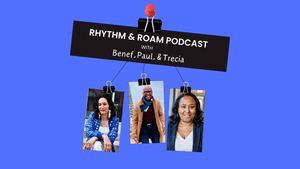




In this episode, we sit down with Renae Ninneman, founder of Going Beyond Tourism and CulturalQ, to explore what it really means to develop cultural intelligence (CQ). We go beyond surface-level awareness to unpack how CQ shapes how we travel, connect, and show up in diverse spaces.
Renae shares her journey into cross-cultural work, breaks down the difference between cultural awareness and true intelligence, and explains how intentional preparation can transform your travel experiences. We also dive into real-life applications, including a look at Benef's cultural intelligence assessment results and what they reveal.
Whether you're traveling abroad, working across cultures, or just trying to better understand the world around you, this conversation will challenge and inspire you to move beyond tourism and into meaningful connection.
Visit us at RhythmAndRoam.com for more!
[00:00:00] Back your bags were on the move. Rhythm and Roam got nothing to lose. Culture clash from coast to coast. Misconceptions we chasing ghosts. I've always considered myself like very aware of myself personally and just, and I think of other people, but when I did the assessment, there was so much more in there that I just simply either didn't have the vocabulary for, or frankly just wasn't aware of. Like I would just go about operating the same way. Right.
[00:00:30] With everybody not thinking that I could adapt in this situation or I could, because I, you know, I have the knowledge now I can adapt. So the definition of cultural intelligence is the ability to interact effectively with people from diverse cultural backgrounds. It's a skill. It's a capability. So we're going to go beneath the surface in this episode. Welcome back everyone to another episode of Rhythm and Roam podcast.
[00:00:59] My name is Benef Shea and I'm here with my cohosts, Paul and Trecia. Today's episode is super, super fascinating. We're speaking with Renee. And she's the owner of Beyond Tourism, cultural training and travel. And she does a lot of work with cultural intelligence. This CQ is the acronym. And so we are speaking with her today about what is that? Like, what does it even mean? Because I think I'm pretty culturally aware. We all do here at Rhythm and Roam. That's what our podcast is about. That's what our podcast is about.
[00:01:28] But there's more. There's more. We just are at the tip of the iceberg. And so we're going to go beneath the surface in this episode. So please do listen and offer us your feedback. Please do subscribe if you like our content. And we also would like you to visit our website, rhythmandrome.com and sign up for our newsletter. Let's get to it. If you had to live in a different country for a year, which one would you choose and why? Well, this is a great question because I think about this a lot.
[00:01:55] Like, if I were to move to another country, I'm going to stay in the Netherlands. And that's because my ancestors are all from the Netherlands. My grandma was a first generation immigrant. And so our family, my family, like, if you look at the family tree, Dutch through and through. Grew up in a small town called Holland in Michigan. Oh, yes. Yeah, yeah. Holland, Michigan. They have a tool of time. I did Dutch dancing in high school. So. Oh, neat.
[00:02:25] And that's my like. And you have clubs? Your chips? You have the real clubs. I also am really curious about my, the country itself. And I would love to live there. I'm fascinated with their direct communication. So I hope to go there sometime. Oh, cool. What smell, what smell reminds you most of a specific place or time? When I was in high school, I had this, uh, like body spray lotion stuff that I used to get from Victoria's Secret called Enchanted Apple.
[00:02:53] So that always reminds me of like my junior and senior year because I wore the crap out of that. And everybody was like, oh, that's the Renee smell. So. Uh-huh. Uh-huh. Uh-huh. Uh-huh. Uh-huh. Uh-huh.
[00:03:23] Going straight into a dive and straight into what is cultural intelligence and how is that different, you know, from cultural awareness or even sensitivity? That's a great question. So the definition of cultural intelligence is the ability to interact effectively with people from diverse cultural backgrounds. It's a skill. It's a capability. And so I think that's how it's a little different than sensitivity or awareness because those are,
[00:03:52] you know, those are kind of different like sensing, you know, feeling. But the cultural intelligence is the skill, right? It's the practice of adjusting your behaviors, adapting your behaviors so that you can make other people feel at ease and make more effective connections with other people from different cultures. Interesting. What do you think of that? That's interesting because I'm trying to... The more you're talking about it, I'm just like, okay, so how does that...
[00:04:21] Does that relate to race? You know, different type of way of communicating with... Like, it's a lot of words. And I'm trying to, like, unpack it. I like it. And we're gonna, like, dissect it further because I've always considered myself, like, very aware of myself personally and just, and I think of other people. But when I did the assessment, there was so much more in there that I just simply either
[00:04:49] didn't have the vocabulary for or, frankly, just wasn't aware of. Like, I would just go about operating the same way. Right. With everybody not thinking that I could adapt in this situation or I could... Because I, you know, I had the knowledge now I can adapt. Yeah. We'll definitely talk more. And I definitely have never heard of it before. No, yeah. I was actually very jealous of you that you got, that you did this because I was thinking
[00:05:14] I really wanted to take part in this because I consider myself cultural, you know, very culturally intelligent because of the ways that I adapt. I'm very much a chameleon, but I have no idea if that is what it is. And the funny thing is, is in my course study last semester, I actually took a course on, on a professional business abroad. And it touched on this, touched on CQ. You can't, you can't not study it without it.
[00:05:41] And actually the book that I requested as my secret Santa gift for this Christmas was the cultural map, which is, which was of course explained in that as well. And so it was very interesting that, that your discussion came along with this very topic. And I'm like, I really wanted to take that yesterday. I just wasn't available. That book is, that book by Erin Myers. That's a really good one. I've read that one too. She does a great job, very business focused for sure.
[00:06:09] So the model that I work with is through the Cultural Intelligence Center or the CQ Center is what it's called. And so there's sort of, you know, these different like fields and like, what do they call them? Like lines of research or like, you know, like how it goes back, you know, many years. And cultural intelligence is, is based in like intelligence, like IQ theory, I guess. Yes.
[00:06:35] But it also goes back to, you know, like Geert Hofstede, who's one of the original researchers who is Dutch. Yes, exactly. With IBM and kind of came up, like he was one of the original researchers to study these cultural values. But I like Erin Myers model too. I've read her book and I, I'm like a super nerd about this kind of stuff. I'm like, ooh, let's talk about all the various models we can find on cultural differences and intelligence. I just love it.
[00:07:04] And there's a lot of nuances and how you can use them specifically, not just within business, but just if you're inserting yourself into a different culture and how those nuances and just lack of better words, soft skills that you can acquire or should acquire to be able to function within, you know, within that community. So it's, it's really, really interesting. And I'm, I'm super psyched for this. So let's dissect. Well, right. So I had the opportunity to take the assessment.
[00:07:30] So it was several questions and I wish I had taken a screenshot so I could remember what the questions were, but it was like asking me different, like what I would do in different situations or what would I prefer between one or the other. And so I did that. And then there are five different, what are they called? Categories? Capabilities. CQ capabilities. So we have the CQ drive, which is, I mean, I guess I could read them all, but you could probably can explain them better. So I'll let you do that.
[00:07:59] I'm like, I don't need to just read it off of the screen. There's CQ drive, which is like your motivation and how much you like and enjoy interacting cross-culturally. There's CQ knowledge. That's the learning, the things you can do, the gathering knowledge, information, like how did things operate in different countries? There's a CQ strategy. So that's where we talked about, like there's planning awareness and checking within CQ strategies. So like strategizing about your cultural interactions.
[00:08:28] And then the last one is CQ action. And that's where like you're actually adjusting and adapting and changing your behaviors to adapt to whatever environment you're in. So that might be, there's a lot of, there's a variety of sub dimensions, which we don't need to go into right now, but then, so those four capabilities sort of build on each other and you just sort of go through them over and over again. And that's the skill. So as you kind of keep looping through, you do the knowledge and you have more interactions,
[00:08:56] every interaction you have, you have an opportunity to learn, right? And so, you know, then you can adapt better and then you can learn how to change your behaviors a little bit next time, if that's something you want to do. So those four CQ capabilities are my favorite thing about this particular model. Again, there's so many models, but I like this a lot about the CQ models, these four capabilities. What, what I wanted to ask you Renee is what actually sparked your passion for
[00:09:25] learning about CQ intelligence in general and being able to offer this? Yeah, I, so I lived in South Korea for a year after I got my bachelor's degree. Yeah, we have those locations in common. Mm-hmm . Yeah, I love that too. So I, I taught, I taught for a year in the Hagwon, so I taught English to kids. And so, you know, I really did my best to learn the language, meet Korean people,
[00:09:51] and get to know the culture, but I didn't know what I was doing in any way, shape or form. And so when I came home, actually, one of the first books I read was one of Geert Hostie's books. And like, my brain just like exploded. I mean, you can explain what happened to me. I mean, like, I can under, like, there's words to describe the differences that were just sort of like all around me. And I couldn't like explain what was happening, but I knew some sort of thing related to culture
[00:10:20] was play, but I couldn't describe it. Like you can describe these things. And so like, that's, that was 20 years ago, almost. So since then, like that experience in South Korea definitely like put me down a different path in my life where, you know, I worked with refugees and immigrants. I did refugee resettlement for a while. I've worked with refugees and immigrants at a variety of settings. Everywhere I go, I end up in some sort of global setting.
[00:10:46] I've worked with people from more than 30 countries just here in the US without even traveling. And so I, and I remember when the CQ center was just starting up and I followed them on social media for, for many years. And then I just got their assessment probably two or three years ago. I took one of their first certifications. And so it was really just a matter of like my experience. Like I lived in South Korea and it was my own curiosity and drive and like interest to learn
[00:11:16] about the world and to explain what had happened to me and the things that I had experienced. And I see that too now, like a lot of people, they just sort of brush off like a culture is different. They sort of don't even try to explain or understand the difference. And I think that discussing the differences is so important so we can learn from each other and sort of surface those uncomfortable experiences and address them so that we can communicate and connect a lot better.
[00:11:45] So it was ultimately that, that you're in South Korea that started me on this path that I've been following for a long time now. So here's another thing that I wanted to ask to Renee is if anybody, anybody on here that's listening to our episode and stuff like that, you know, what is it, one thing that someone could take away right now from this episode about culture and what would it be and shed some light on for anyone who's listening? Yeah.
[00:12:14] Well, I think that, and this is what I talked about with Benefshe too, I would, because reading through your booklet, you know, and you guys are already all very high on your observation skills. And honestly, like observing yourself and observing others is a huge part of it. And Benefshe did, was high on her ability to observe and her awareness and her assessment. And so like, that's really what you guys talk about a lot. And that is huge. Yeah.
[00:12:43] It's huge just to be able to like be self-aware and then also be aware of what's going around you. So, and I always tell people like, if you want to increase your cultural intelligence, you first have to understand yourself because if you don't even understand how you are, like what, which of your behaviors are stemming from your cultural upbringing, then you're never going to be able to adapt, right? You have to start with your own understanding. Then you have to learn how to identify these values and these differences in other people.
[00:13:13] Like, okay, well I'm individualist. Okay. I'm coming up against something collectivist behavior. Now the final step is adapting, right? So you guys are always, you're so strong in those first two, like aware and observe, like observing yourself and others. And so I think, um, just for people to keep doing that, you know, cause it's, it's the most important thing to get, to get started on this cultural assault journey. Yeah.
[00:13:41] Like using it as a tool to, to better understand ourselves. Yeah. I mean, that's huge to just finding a way to communicate more effectively and also just understanding of others. And so, I mean, I thought it was, I'm still like, Yeah. It sounds easy, but it's not easy, man. It sounds easy. It is definitely not easy based on what we're talking about now. I thought I had it in the bag too, but I'm actually questioning myself. Honestly, I'm questioning myself. And we didn't even, we didn't even talk about the, there's like 10 different cultural values.
[00:14:09] And so going through those and I was just like, you know, like. Yeah. Cause the amount of times that I'm traveling, I'm just like, now you're going to have it in my head now, Renee. Thanks. I'm joking. It's a, cause I'm actually, you know, traveling this weekend to, to Switzerland. So maybe I'm going to be like, let me see what it, you know, but it's. The Swiss are pretty easy though, man. I mean, come on. It's hot cocoa. It's similar. Yes. It's similar, right? And similar. Yes. Yes.
[00:14:40] Hot cocoa, skiing, you know, the good life. No, but no, seriously. Yes. Definitely a similar culture. Yes. Yeah. It's just interesting because like I said, I, I'm really fascinated by culture. And that's one reason why I travel, not because I get to go to only a different country or wherever I'm going is because I love to just see how people live and eat and what I can and can't do. You know what I mean? Like when you're immersing yourself in stuff like that. So that's all fascinating to me.
[00:15:09] But now you add another layer to it. A lot more layers. A hole underneath the iceberg, dude. Well, I've been all the way up on top of the iceberg and loving it. I'm like, yeah, I know culture. And I'm just like, well, shit. Ignorance is bliss. And it's true for them. Because I'm sitting here like. And you can't like put the veil back over. Like now that you've like peaked. Which you know you're not. That's my point because, you know, when I go places, I'm like, oh, I can blend in. Meaning I can immerse myself and understand what I'm doing.
[00:15:38] If they're tap dancing, then damn it, I'm going to tap dance too. Do you know what I mean? Because, and I'm good at that. But that other piece is a layer. Now I have to like. Well, especially for you, Paul, because you've spent. I mean, if you're just visiting, it's a lot. I feel like it's easier unless. But because you're living there and you're coming up against these cultural differences with the French all the time that you're like, I don't understand why they do it this way. Like, this is crazy. Why are they so passive aggressive? So do you.
[00:16:05] And going and understanding like yourself and how you were brought up and then like how the French, their cultural values, you can maybe come to a little bit more of an understanding of, okay, like this is why I'm so frustrated. And people are very strong minded. That's the other part to it. I know we haven't touched too much on it, but we will once we talk individually. But there's a lot of strong minded interaction of people. And I think that also impact a lot of the cultural intelligence that you're talking about too, as well, Renee.
[00:16:34] Well, there's something about and Tricia, you probably learned about this too. Tight versus loose cultures. So there's some cultures that where you have to follow the rules because it's tight. It's you just have to. And then there's loose cultures where, you know, it's not such a big deal. The US is much looser, but France maybe is tight on some things and loose on other things that maybe you're not used to. You know what I mean? And so that like what, what is tight?
[00:17:03] Like what is like, you have to do these things and what is, it's not such a big deal. So you have to navigate that everywhere you go. Where like, if you do, you do a behavior that is very strictly against the rules, people are going to be shocked at your behaviors. Like what I'm eating. Other parts of the world, maybe it's not so big of a deal, you know? Cause, but it depends if it's tight or loose. Mm-hmm. Correct. Yeah. Yeah. They have a lot of eating, eating things. They have a lot. Also he's talking about their eating rules.
[00:17:32] You cannot eat. You can't walk and eat at the same time. Unless. Well, you went up in arms on one of our first episodes about the burger situation and the French fries. Like everything is a knife and fork. And they were like, no, cut that hamburger with a knife and fork. And you're like, you went like nuts over that. But that's a cultural. Exactly. And this is where I said, no, this is where I said I learned to adapt because guess what I do now?
[00:18:01] I find myself doing it a little bit more than I do. Do you do it when you're in America or cause then people be like, what in the hell is he doing? No. Yeah. Because people didn't make fun of me, but it's, it's funny because I was just with, uh, a couple of French friends of mine, you know, during new year's Eve. And we did have burger for lunch one day. And I remember I told him, I was like, this burger is too big. You know, too big. And I was like, look, yeah. Well, what I did was I apologized to them and I said, Hey, are you okay with me using my hands for this?
[00:18:31] Like the fact that I'm saying this drove me the nuts in my head that I'm even asking for permission. Oh, this is high CQ action though. Absolutely. You're changing your behavior. I do. I don't want to. I know you don't want to, but you are. And that is high CQ action because you're making them more comfortable with you. And that's what it was because they were, they were very, I could see in their face.
[00:18:59] They were so happy that I did ask them. And they were like, no, no, no, go ahead, please. You know, and stuff like this. But the point was, but the funny thing is I'm sitting and I still felt bad because they were using that and I'm sitting here with a hand and now that, okay, fine. I'll just, because even as you were telling that story, Paul, I was like, I was cringing for you inside because I knew you were the little piece of you died that day.
[00:19:28] Oh my God. Like, cause you can't really enjoy, you from Nebraska, Renee. You can't really enjoy a nice piece of burger without it in your hand. Yeah. I mean, I usually, I usually order Omaha steaks. You know about Omaha steaks and stuff like that. But you're using a fork and knife with that though, right? Like you're not like. No, burger, the burger, the burger, the burger. Well, she was, yeah, the burger. I thought you meant like a steak steak. No, no, no, no, no. The burger.
[00:19:55] But even with the French fries, you use your hands with French fries, but not here. No, I don't. Everything is fork and stuff. Renee, this has been a, this has been a fascinating conversation. I, as you can tell, we are thoroughly involved in what's going on. And it's really funny when we, we, I'm thinking now we, we probably should have treated ourselves or known about you previous to this, even when we started the podcast, because this was really interesting. But I don't know. I kind of like it where, where we've met you in our journey, actually.
[00:20:25] Knowing that, you know, we, we have been, we have been intelligent, culturally intelligent from the get go. And that was actually probably what spurred us in the first place. So it's really interesting. So thank you so much for today. We're definitely going to share your website with our audience at, and you're at going beyond tourism.com. And then of course, your website at cultural cube.com. We'll also share those with the audience. That's the CQ center. That's the CQ center. Excuse me.
[00:20:55] That's right. The CQ center. So we'll share both of those. Yeah. Along with your information. Again, thank you so much for today. And we, we hopefully will cross paths again and, and we'll, I'm sure Paul and I are now are going to be calling you for our appointment. Yeah. I need to figure this out now. Yeah. Thank you for having me. Yeah. Of course. You guys are great folks. I really enjoyed the conversation. I really enjoyed you telling us like, thank you for teaching me something that I was,
[00:21:23] I thought I had a down pat. As always, don't forget to please do hit that subscribe button. And it doesn't take no more than a couple of seconds just to do that. And by all means, also please do while you're at it, visit our website at www.rhythmandroam.com. And while you're at it on the website, just scroll down to the bottom and subscribe if you have it to our lovely monthly newsletter that also doesn't cost you anything.
[00:21:53] And also don't forget to buy us a coffee. Hook us up. One more thing, because you may have heard Renee mention our little booklet. And so if you do not have a copy of our little booklet, please do go to it. You can get that at our website as well. Hook to. Pack your bags, we're on the move. Rhythm and roam got nothing to lose. Culture clash from coast to coast. Misconceptions we chasing ghosts. I don't know about it. The trick is happiness. If Wavera has been on this level, it comes to you to go to theоas levels,