
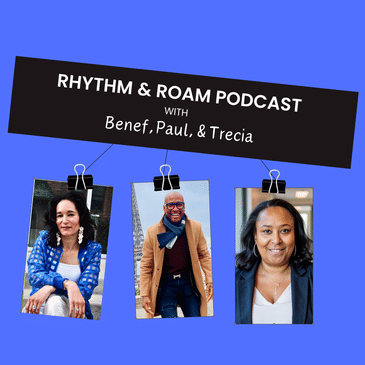



Join Benef, Paul, and Trecia as they kick off the New Year with exciting adventures in culture and travel. In this engaging episode, they chat with Heather Courtney, an inspiring American expat and founder of "Black In Portugal." Heather reveals the vision behind her organization and how it creates a vibrant community, fosters meaningful connections, and promotes a true sense of belonging for Black expats. If you've ever dreamed of moving abroad, this episode is a must-listen, as Heather shares her expert tips and strategies for thriving in a new country. Don’t miss out on the insight and inspiration! This is an episode not to miss as Heather discusses her tips and tricks for living overseas.
[00:00:00] The first country I ever visited was Lisbon, Portugal. And I was in the Navy and this was like my first dose of anything abroad, you know. So when I came to Portugal back in 2010, I didn't see any Black people. I remember I saw like a lot of the Roma gypsy people. They were like, you know, asking for money, the babies, we gave them money. Then we were at the Hard Rock Cafe, we were drinking.
[00:00:29] It was like a blur. I don't remember anything except those key factors. But then we did some more traveling on deployment and every port that we would hit, I'm like, wow, these people are really living out here. These people are thriving, you know, not the mindset of what America does, how other countries are living.
[00:00:53] Hey y'all, welcome back to another episode of Rhythm and Roam where we discuss our travel adventures and all the misconceptions and craziness and things that we experienced in the world.
[00:01:04] And we have a special show for you today. Well, we'll just get right to it. We got our special guest and we're going to welcome her to the show.
[00:01:13] My name is Heather Courtney Proctor. I do go by Heather Courtney. You might find a lot of articles under Heather Proctor, but we are the same person.
[00:01:22] I am the founder of Black in Portugal and Eligible Malneglected. These are both Portugal based communities, mainly in Lisbon, but we also have smaller communities up north in Porto, Avero, and not too many in the Algarve, but mostly everyone is in the Lisbon area.
[00:01:43] I will say like, I have not been anywhere. I can particularly say that people have not been severely unfriendly.
[00:01:52] I've been, I'd say, I think I've been to five continents. I think I've been to like 30 some countries. And I would say that besides Portugal, Portugal is like a horn in the realm, but majority of people in Portugal are friendly. Mexico, just everywhere in the world.
[00:02:09] So I have found that people have been very welcoming, especially if you try to speak the language, even though we mess up.
[00:02:17] Yeah.
[00:02:17] They are welcoming, but yeah, I think those keeping an open mind and knowing that things don't function in the U.S. like they do in other countries.
[00:02:27] I had not realized that you had traveled so extensively. So this is definitely, you know, eye opening for me.
[00:02:36] What would you say in your opinion? Why is it that Americans and particularly black Americans having, you know, your organization, Black in Portugal, specifically, why do you think so many Americans are, you know, traveling from the U.S. to Portugal or, you know, Europe in general? Why?
[00:02:55] So, um, okay. Several things. I think this was like a three part question. So I think that black Americans are waking up as far as travel. I think, you know, before, you know, growing up, I thought only rich white people, people that were like celebrities could travel. Like, yeah, we were going to my great grandmother's house. It was great. We're making like little video. That's all my cousins, my aunts. Like, yes, that was fun.
[00:03:21] But I didn't see anyone in my family outside the military that was traveling to different countries that are having these things, you know, unless they're like missionaries or like their work has symptoms.
[00:03:32] Sure. So I feel like the lack of inspiration or lack of seeing it or hearing about it growing up is one of the things. Now, once you're an adult, now a young adult, now you have, oh, I'm thinking about traveling. Where do you want to talk to? You're, oh, but don't go. What about, what about this? What about that? Don't go to Mexico.
[00:03:51] Well, what if you have an emergency and you don't have anyone. It's like the fear. Now it's like the fear they're instilling, instilling in you, you know, because it's the fear of the unknown. Like, oh wow. Well, they are right. Like, what if I have an emergency? Like, I don't know anyone out there, you know?
[00:04:07] And you also have the fear, not only from your friends, you also have the fear of your family too. That is just like, well, what if, and what if, and you don't need to going down there.
[00:04:15] Excuse me. You know, and now we're in this, this, this era of everyone's documenting their life. Like social media has taken off now. So now you see all these black influencers. I'm not talking about the ones that are like, everything's like perfect with the color grading and everything. You're seeing regular, regular people like myself going to travel. You're seeing the LGBTQ traveling in countries saying that it's safe for people, um, for, for them.
[00:04:43] You're seeing people that are plus size can say, I was here. I didn't have any issues. I'm loving it. You have people that have medical issues that are traveling saying I'm having the best healthcare in these other countries.
[00:04:54] You have people that are single moms that God forbid, you know, they take their child to the country because they're never coming back. I mean, I'm not coming back still. Um, it's there's community out there for you. You have the 65 plus community that they're part of that generation that listened to their grant, their parents,
[00:05:13] their grandparents, their grandparents, their grandparents that don't do this. They didn't do it. You know, now they're their best life. So that's really, really interesting.
[00:05:22] Yeah. Yeah. I would have to agree with that as well. Um, to a degree.
[00:05:28] And I, would you say that it's also, you know, it definitely has to do with politics, um, you know, of our recent politics and our, you know, and now I would say within the last 10 years,
[00:05:40] if not more, but specifically I would say, you know, between now and the last 10 years, would you say that that's, would you agree that that's part of it as well?
[00:05:49] I think that it is. And it's also wanting better for our children. You know, I think that there are a lot of videos on YouTube or even the Tik TOK, even reals.
[00:06:00] They're like, um, this is for instance, school lunch in South Korea. This is school lunch in Mexico. This is school lunch in Sweden.
[00:06:08] And you're looking at how nutritious the food is. And you're like, wow, like we had Elio's pizza, taco rice, leftovers, whatever. That's what we were getting.
[00:06:18] And then you also see, you know, these, these children, process. Yeah. You see these, you know, kids, unless you come from a bilingual family, you know, in the U S you're not learning these languages fluently.
[00:06:33] These, these kids growing up in Europe and other countries, they're speaking at least two to three languages.
[00:06:38] Yeah, for sure.
[00:06:39] And for us, I'm just like, we're, we're behind on the, I know my little, a few words in French, a little bit of, a little bit of Spanish, Portuguese, but I, we're not navigating around the world in the U S where we're openly speaking these languages because everything's like, we're America speak English.
[00:06:57] And unless you have these family members that might speak Spanish or might speak French or might speak, um, another language, like you're not using it.
[00:07:06] And also the level of education, you know, I feel like the education is more to set you up in Europe and outside of America than it is in the U S.
[00:07:21] I feel like the U S is still basis is education from like the 1950s.
[00:07:26] Like, okay, we're in this robot world where you go to school, then you go to college, then you get a job, you meet your sweetheart, you get the white house, you get the dog,
[00:07:35] you get the boy and girl, and then you are complete.
[00:07:40] You know, it's like, we're not in that, we're not in that mindset right now.
[00:07:44] You don't, I mean, yes, go to college.
[00:07:46] If your degree, you need it for your degree, but now we're in a space and era where people are getting certificates.
[00:07:51] People are doing different classes.
[00:07:53] They're a traditional college university.
[00:07:56] Yeah.
[00:07:57] Not as required like it was like in the 1950s, you know, people are doing digital marketing.
[00:08:02] They never had a digital marketing course in their life, but they have a skillset and they're good at it and they're making money.
[00:08:10] So I feel like there's so much it, the U S I feel like it's keeping everyone in this box while the rest of the world is just like, okay, yeah, we have this, we have that.
[00:08:23] You can come go do what you want.
[00:08:25] If you want to go to school here for $4,000 for the semester, for the whole year, whatever, like it's more, it's, it's more achievable.
[00:08:32] So now back to the politics side, I think that right now, especially with everything that's happening, even for like the past, I feel like eight years, I think like it's just been getting worse and worse and worse.
[00:08:45] And I think people are fed up, you know, we're feeling that yes, our votes do matter.
[00:08:51] However, they're not, I, I feel like stuff is already in the background brewing, you know?
[00:08:57] So I think that some people might be feeling like, yeah, I'll vote, I'll vote.
[00:09:03] But did my vote really count for what's really going to matter?
[00:09:07] Am I going to have these, these, these laws put in place, wherever the law might be, will it affect my kids?
[00:09:13] But your daughter is so brave to just like go to want to go to all these different countries, like with school and friends.
[00:09:22] And I don't think my kids, I don't know that they would have, I mean, because we were traveling around with different army bases, but I don't know how they would have been just being like immersed completely in another culture and society and language.
[00:09:37] I feel like you're kind of thrown into it.
[00:09:40] For my daughter, at first she was just like nervous.
[00:09:44] She was like, I don't have any friends.
[00:09:45] Yeah.
[00:09:46] But side note, I did pull her out of school in fourth grade.
[00:09:49] Like she's been, I don't believe in the school board, the system, everything.
[00:09:52] So I pulled her out and was homeschooling and unschooling and world schooling.
[00:09:57] So we were doing a lot of traveling and school focused activities.
[00:10:00] Hands on.
[00:10:02] But, um, yeah, I really think it's, you know, encouraging your kids to come outside their comfort zone.
[00:10:09] You know, this, this isn't the U S when we're not in our, in our own little town, you know, town where everything is just so normal.
[00:10:16] But I try, I try to, or I did encourage her to say, Hey, you never know.
[00:10:21] You might be, you know, these might be lifelong friends of yours, which one of them was, she just turned 18.
[00:10:27] She just flew out to Lisbon and they spent a week, uh, together running the street, spending my money.
[00:10:34] So literally like spending my money.
[00:10:36] So I'm just like, well, what if you never said hi to her?
[00:10:39] What if you never tried to be friends with her?
[00:10:41] What if like, you just like stayed in your little bubble.
[00:10:43] Now you wouldn't have, you know, someone who you could travel with in a few minutes.
[00:10:57] I go to Disney every year, nothing wrong with Disney, but I'm just like only no Disney.
[00:11:00] Like those are their trips and they can't relate to it.
[00:11:04] Navigating customs, navigating a new language, trying these particular foods in different countries.
[00:11:10] And that's one of the things that McKenzie, my daughter's name is McKenzie.
[00:11:13] She struggled with in the U S so we were doing all these things.
[00:11:16] And like her friends just couldn't relate.
[00:11:18] They were just like, what's like, you're traveling, but we're going to Disney.
[00:11:22] Like you don't want to go to Disney.
[00:11:24] No, we don't want to go to Disney.
[00:11:25] It's not like every year, but that leads it to the next question is though, because like,
[00:11:32] so did you and your daughter have any misconceptions before you were traveling to these different
[00:11:37] countries?
[00:11:38] Were there things that you noticed that you thought were going to be a certain way that
[00:11:42] weren't or anything that really surprised you once you got there?
[00:11:48] Um, well, I tried to travel and have my daughter keep an open mind.
[00:11:52] We all know, like as Americans, we're very privileged and we unconsciously think we're the best.
[00:11:58] Like, it's just like, we, we have everything in America.
[00:12:01] We do this this way.
[00:12:02] Like, it's just something that's just built into our brains, you know?
[00:12:06] But I would say the bureaucracy in countries is the most eyeopening.
[00:12:10] Like, I'm just like, what logic does this make?
[00:12:15] Like how Portugal, like, why are we still using paper?
[00:12:20] Like, please hire some Americans that can get the job done faster.
[00:12:24] Mexico.
[00:12:24] Mexico.
[00:12:25] I understand we have CP time, but Mexico time.
[00:12:29] Yeah.
[00:12:30] A totally different realm.
[00:12:32] Okay.
[00:12:32] If you say you're coming at one o'clock, maybe I might expect you 1230, maybe two o'clock,
[00:12:39] but not the whole next day or eight hours later.
[00:12:42] You know, like things clearly don't make sense in my, my brain.
[00:12:48] I'm just, I'm trying to figure it out.
[00:12:49] It's like that meme with like the math equations and like they're looking around,
[00:12:52] like, I don't get it.
[00:12:54] But then there are some things that totally make sense.
[00:12:56] Like I was getting water delivered, fresh water dress.
[00:13:00] You can't drink the water in Mexico.
[00:13:01] 90 pesos for three jugs of water.
[00:13:05] Wow.
[00:13:06] Oh, wow.
[00:13:07] I think that's like, I don't even know how much 90 pesos is anymore, but it's a lot.
[00:13:13] Not much.
[00:13:14] And I think the biggest thing is that people are opening their eyes now.
[00:13:19] Like there is light out of there.
[00:13:21] When you really like dive deep and look to see, you know, what working professionals
[00:13:27] or people of color, working professionals are doing other countries, what life is like,
[00:13:32] how they're not working 40, 60, 70 hours a week, how they do have time off, how they
[00:13:38] do have parental leave, how, you know, we went to Amsterdam, um, 50, 50 bucks round
[00:13:45] trip to go to a different country.
[00:13:48] Luxembourg.
[00:13:48] I think we paid 30 euros for a round trip.
[00:13:51] You know, you can't even take the Greyhound to the next city over, you know?
[00:13:55] I just, I actually just, it's funny you mentioned that Heather.
[00:13:59] I actually just, uh, priced out trying to take a train, an Amtrak train from Houston
[00:14:04] to Denver.
[00:14:05] And, uh, it was going to cost $1,200.
[00:14:07] Yeah, that's ridiculous.
[00:14:10] I trained.
[00:14:11] You're up with that money.
[00:14:13] Exactly.
[00:14:13] I mean, you can, you can do more than that.
[00:14:16] You can do that.
[00:14:17] You could probably take the train, stay in a really nice hotel and eat for days.
[00:14:24] Yeah.
[00:14:25] Yeah.
[00:14:25] Of $100.
[00:14:26] What are, what effects do you think, you know, with tourism or even the mass tourism,
[00:14:31] have you noticed, you know, from on the, you know, the local population and the economy
[00:14:36] when it comes to where you were at in Portugal?
[00:14:38] Portugal or even if you know right now in Belgium.
[00:14:42] So I'm not too sure about Belgium, um, but I can speak on Portugal.
[00:14:46] Um, so tourism and the expats coming over two totally different things.
[00:14:51] Tourism is great as far as helping the economy.
[00:14:56] No lie.
[00:14:56] Granted, some of the locals don't like tourists here because they mess up their cities, but
[00:15:00] I think that's just like any major city, like it's not going to always be clean.
[00:15:04] Um, now for the expats, we also have a lot of hate because they feel locals feel that
[00:15:11] Americans, even though we're not like the high percentage of people that are coming to
[00:15:15] Portugal, like the French, the British, there's other people, but, uh, just expats in general
[00:15:20] are hiking up the rent prices, you know?
[00:15:22] Yeah.
[00:15:23] For example, that's what I was thinking in Portugal.
[00:15:25] The now I think the, the average of what a local Portuguese makes is 860 euros a month,
[00:15:32] which is under a thousand us dollars.
[00:15:33] Wow.
[00:15:34] Yeah.
[00:15:35] Yeah.
[00:15:35] And it was less than that.
[00:15:36] It was like seven something when I arrived in Portugal.
[00:15:40] So rent is crazy expensive.
[00:15:42] I just moved into a new flat.
[00:15:44] Yes.
[00:15:44] I moved to a new flat in Lisbon with my mom and my daughter.
[00:15:48] And, um, we're paying 2000, 2000 for a three bedroom a month.
[00:15:53] Now my flat, that's a steal.
[00:15:56] No, but it's expensive.
[00:15:57] Cause I just moved out of a two bedroom flat that was smaller and it was $23 cheaper or
[00:16:03] 23 euros cheaper.
[00:16:04] And that was 1973.
[00:16:06] So if you're thinking about the pricing, yes, for us.
[00:16:09] Yeah.
[00:16:09] It's good.
[00:16:10] Like, yeah.
[00:16:11] Yeah.
[00:16:12] If you're only making eight something euros a month and now you gotta pay 2000.
[00:16:17] Yeah.
[00:16:17] Cause the average salary in Portugal is about a thousand dollars, right?
[00:16:23] Well, yeah.
[00:16:23] So a little under a thousand US dollars.
[00:16:25] It's like, what inspired you to create black in Portugal as this safe space and community
[00:16:30] for black people?
[00:16:31] Oh man.
[00:16:32] Um, okay.
[00:16:33] Well, it ties back into Mexico when, uh, I was leaving Mexico.
[00:16:38] I found out I was leaving Portugal very fast, way sooner.
[00:16:42] Cause my visa came back in like 10 days, super fast.
[00:16:45] And I was like, there's nothing going on here.
[00:16:47] Like I'm in the, I'm in the Facebook group, the black to Portugal.
[00:16:50] That's the name of the Facebook group before it was black to Portugal.
[00:16:53] There was like 200 people in there and nothing was going on.
[00:16:57] I was in the POC group in Portugal.
[00:16:58] Nothing was going on.
[00:17:00] I'm like, I gotta have some type of community.
[00:17:02] And, um, my friend Amoya Shante, the one that, um, founded a single mom to travel.
[00:17:07] She said, if the community does not exist, you have to create it.
[00:17:10] And that's what I did.
[00:17:12] I arrived in Portugal on my birthday in 2021.
[00:17:15] And a week later, I hosted my first get together.
[00:17:18] And I started a WhatsApp group, which is the, the Lichbo Melanine Collective,
[00:17:22] which was just meant for people that live here.
[00:17:25] Women, black and brown women that live in Portugal, a Lisbon area.
[00:17:28] And then people were like, oh, we had a good time.
[00:17:30] What's the next, what's the next one?
[00:17:31] I'm just like, I don't know.
[00:17:33] You know, I don't know nothing about me.
[00:17:34] It's like, sometimes.
[00:17:37] And, um, yeah, it just went from there.
[00:17:40] You know, I had, um, the, the Facebook group changed from black, uh, in Portugal to black
[00:17:45] to, I mean, black to Portugal to black in Portugal.
[00:17:48] Uh, the woman that founded the, the Facebook group, she never been in Portugal.
[00:17:52] She was supposed to move here, but she didn't move here.
[00:17:55] Um, so she had handed the group over to me and then, um, my old co-founder and, um, yeah,
[00:18:02] I just started having events and building community like nonstop.
[00:18:06] And people were just like, Heather, what do you sleep?
[00:18:07] I was like, I don't know.
[00:18:08] Beyonce got the same thing.
[00:18:10] I do.
[00:18:13] And, uh, this really was, um, I had a lot of time because I'm retired from the military.
[00:18:18] I don't work.
[00:18:19] You know, my kid was in school.
[00:18:21] Like my dog was looking into my soul every day.
[00:18:23] I was like, I gotta do something.
[00:18:25] For me, it was just very therapeutic.
[00:18:27] Uh, just making connections, meeting people, like really seeing how the world worked outside
[00:18:32] of the military because I got on, I didn't have a job.
[00:18:35] All I knew was military.
[00:18:36] So yeah.
[00:18:38] So I, I spent three years, like a nonstop building and making connections with locals,
[00:18:44] uh, local community here, even though I wish it was, my relationship was a lot stronger,
[00:18:48] but with me running it one person with black and Portugal, I really had to choose like,
[00:18:52] where do I focus?
[00:18:53] And I felt like the focus were on people that were trying to move to Lisbon or move to Portugal
[00:18:58] and people that were here that were really trying to, uh, make connections and build their
[00:19:05] own little migrant community.
[00:19:06] So many migrant communities have formed because of black and Portugal and, uh, a safe space
[00:19:11] is really needed because there are, you know, I've been in other non-black spaces online.
[00:19:17] And I remember it was like in one of the, one of the travel groups or Portugal groups,
[00:19:22] a girl was asking, um, I'm looking for black women in this area, you know, and all the
[00:19:30] non-white, all non-black people have done, well, why does it matter for color?
[00:19:33] You know, if you're looking for friends, why do you want it just to be black people?
[00:19:36] I'm like, cause it hits different.
[00:19:38] Like I, I can joke around and get stuff like you guys get certain phrases or expressions.
[00:19:45] Or expressions.
[00:19:47] Yeah.
[00:19:47] And it's, it's, it's not that it's a bad thing and they don't get it, but then like,
[00:19:50] it kind of takes, it takes away from that moment when you're like, you're in your moment,
[00:19:54] you're conversing and you're just like, yeah, but then like now you have to sit and explain
[00:19:57] it or like, they just still don't get it.
[00:20:00] You know, our struggles, you know, from people, uh, black people, black and brown people, you
[00:20:07] know, it's different than a white struggle.
[00:20:11] It's different from an Asian struggle.
[00:20:12] Like, I don't think I could sit and say, yes, I, I understand a hundred percent of Asian
[00:20:18] struggle because their struggles are different than the black struggle.
[00:20:21] Our, our struggles are different than the Latinx, Latinx struggles.
[00:20:26] Like there's some things that they've experienced that we may not have experienced.
[00:20:29] You know, there are things that, uh, indigenous people have experienced that we have not experienced.
[00:20:35] So if they want their own safe space, yes, it's not, it's not my place to say, I want
[00:20:41] to be in your space.
[00:20:42] And I find that non-people of color, non-black and brown people love to be in spaces that they
[00:20:50] don't have to be in.
[00:20:51] Like, it's okay that.
[00:20:53] Well, you don't have to explain yourself.
[00:20:55] Yeah.
[00:20:55] I don't think so.
[00:20:56] It takes a lot of that pressure and that, because when we do go out in these spaces where
[00:21:01] we have to, you have to be a chameleon.
[00:21:04] You really have to try to fit in.
[00:21:05] And that is just one spot where you do not have to fit in.
[00:21:09] You don't have to try to be anything but yourself.
[00:21:13] Yeah.
[00:21:13] My energy's not draining.
[00:21:15] I'm not saying that because we need black spaces or we need minority spaces.
[00:21:19] We're anti-white.
[00:21:20] Like, that's not what it is.
[00:21:22] You know, my, my, would you compare that to, you know, if you're a golfer, if you're
[00:21:28] a tennis player, if you play basketball, it's the same thing.
[00:21:32] It's the same thing.
[00:21:33] It's you talk the same way you, you, you know, you, you understand the lingo you understand.
[00:21:38] So that's, that's kind of, you know, the equation, right?
[00:21:41] Why would I want to be there?
[00:21:42] I don't know what they're talking about anyway.
[00:21:43] Like, right.
[00:21:44] Right.
[00:21:44] There's some of the other events that people can plug into if they're coming to Portugal,
[00:21:48] if they want to find you on social spaces, where can they find you?
[00:21:51] Oh man.
[00:21:52] So the best place to connect with the community in real time is not Facebook because the algorithm,
[00:21:58] like people don't see posts.
[00:22:01] It's just set up very poorly.
[00:22:02] We are on a platform called Nas NAS, which is an app, which is amazing.
[00:22:08] They're launching just like all over the world.
[00:22:10] They just, they have like a Nas retreat in Dubai where influencers come there.
[00:22:15] They have a summit happening in Singapore.
[00:22:19] But that space right there is where you can find all of our WhatsApp groups and subgroups.
[00:22:24] We have resources on there.
[00:22:27] All the events that are upcoming are put on their meetups.
[00:22:31] That is the number one space.
[00:22:33] The second will be Instagram.
[00:22:35] I do post a lot of after the fact events.
[00:22:38] So after like the pictures are taken, I'll post them on Instagram.
[00:22:41] But to get a lot of different perspectives, I would definitely say join the Facebook group.
[00:22:48] There are thousands of posts on there.
[00:22:50] I think we have, I think almost 26,000 in the Facebook group.
[00:22:56] And then the Instagram, I think might have like a little over 20,000 followers.
[00:23:02] And I think on the Nas were, I think we have like about 3,000, 4,000 on the Nas app.
[00:23:09] That's so cool.
[00:23:10] Do you think you'll start?
[00:23:11] Sorry.
[00:23:11] I just want to know if you think you thought you'd start something like that in Belgium.
[00:23:16] In Belgium.
[00:23:17] He keeps asking me.
[00:23:18] They're just like, so when's Black in Belgium coming?
[00:23:20] Yes.
[00:23:22] And you know that there's Black people in Belgium.
[00:23:24] So you shouldn't have an issue.
[00:23:26] And there's some issues going on there right now with Black folks and all that.
[00:23:30] You know, I have been trying to connect with the Black community here and it has been very hard.
[00:23:35] It's been very, very hard.
[00:23:36] I've been trying for months.
[00:23:38] I did meet another veteran here, but that was through my friends that run Black in Bali.
[00:23:42] One of the founders, his cousin lives here.
[00:23:45] So I met him.
[00:23:47] And thankfully he's a veteran.
[00:23:48] So he has drawn my veteran questions for here.
[00:23:51] Um, I did start a WhatsApp group for women in the Brussels, Leuven area.
[00:23:56] And there was a girl that joined who said she met me over the summer.
[00:24:00] Um, so that was kind of cool.
[00:24:02] We were at this Jamaican spots.
[00:24:04] Um, I don't know, somewhere in Brussels eating some Jamaican food.
[00:24:09] Um, just really quick from, from your experience, Heather, in Portugal, does Portugal acknowledge
[00:24:16] and does it teach the history of, of the country and how it started in the slave trade?
[00:24:22] Do you, have you, have you been on tours?
[00:24:24] Have you guys, I mean, do you know, now I can tell you from my own personal experience,
[00:24:28] I can say yes, because my tour guide did do that.
[00:24:32] Okay.
[00:24:33] So yes and no.
[00:24:36] I will say that one, if you had the chance to do the African Lisbon tour with, um,
[00:24:42] my friend Naki, a hundred percent do it.
[00:24:44] There's also a book that my mom stumbled across that, uh, has the history of black slavery,
[00:24:52] African slavery in Lisbon in like between the seven, 15th and 17th century.
[00:24:58] Um, and I will send you a link to that.
[00:25:00] You can order it online.
[00:25:02] I don't know.
[00:25:02] They might get internationally, but it's a great book.
[00:25:04] It covers everything Naki has plus, plus more.
[00:25:08] So I will say that the Portuguese for my experience,
[00:25:12] and then from what my daughter has learned in school,
[00:25:15] they don't necessarily acknowledge.
[00:25:20] And this is my perspective.
[00:25:22] Don't acknowledge the severity of the impact of slavery.
[00:25:26] Now, yes, they might say, yes, we were the, the, um, the first.
[00:25:32] And they have like this in the National Geographic Museum,
[00:25:34] and they have like this huge wall and they turn the light off.
[00:25:38] You can see everywhere where they came and colonized,
[00:25:40] like they're so proud of it.
[00:25:41] Even in, um, one of the metro stations there,
[00:25:44] you can see slave ships and slaves just painting them all.
[00:25:48] Like it's, it's, it's, they're glorifying it.
[00:25:50] Um, I don't feel that they will ever take a hundred percent responsibility for it.
[00:25:56] Um, I do think that they do allow,
[00:26:00] like there was a new statue that was put up for, um,
[00:26:04] to represent like the African slaves.
[00:26:06] But as far as, um, saying, yes, we messed up.
[00:26:10] We shouldn't have done it.
[00:26:11] I don't, I don't think any of the colonizers countries are a hundred percent saying,
[00:26:16] here's all your stuff back.
[00:26:18] The British people here, here's all your artifacts back.
[00:26:21] You know, I think someone just loaned it back to the country they stole it from.
[00:26:24] Like, so no, I, I honestly don't feel that way in school.
[00:26:29] I really don't, I don't recall much of anything.
[00:26:33] My daughter learning about the slave trade in any of her studies,
[00:26:37] because the universe, how the schooling is different.
[00:26:39] When they get to high school, they kind of like choose a career path
[00:26:42] versus still learning about history.
[00:26:45] Um, but it's still the history that I did learn.
[00:26:48] I'm just like, oh, okay.
[00:26:49] I'd see it from a European perspective, but in America,
[00:26:52] they said this way, you know,
[00:26:54] but, uh, yeah.
[00:26:57] So, right.
[00:26:57] Heather, would you agree for us to, to continue to travel
[00:27:01] and to continue to, um, uh, to spur on, uh, our younger, uh, generation
[00:27:07] and our children and raise them and to tell them that travel is good.
[00:27:11] You need to, you need to see this for yourself.
[00:27:13] You need to continue to talk to people who don't look like you,
[00:27:16] um, and build community where you are.
[00:27:18] Um, and community doesn't always mean the United States of America.
[00:27:21] So, uh,
[00:27:22] 100% the community waiting out there to welcome you with open arms.
[00:27:26] You bet.
[00:27:27] You bet.
[00:27:27] This has been so exciting.
[00:27:29] Um, Heather, we could probably talk to you for another two hours, honestly,
[00:27:33] but we know you have to go.
[00:27:36] Um, thank you.
[00:27:36] Um, we would love to have you back, um, to talk about, uh, hopefully.
[00:27:41] Black in Belgium.
[00:27:42] Yeah.
[00:27:43] But definitely on another topic, you know, maybe we could talk about medical care or,
[00:27:47] you know, about building community.
[00:27:49] I would love to hear that.
[00:27:50] Um, you know.
[00:27:51] I would love to talk about medical, but you have medical issues.
[00:27:54] So I go to the doctor quite often.
[00:27:56] So I definitely very open to share my experience with getting healthcare and my health issues
[00:28:01] as well.
[00:28:02] Well, that was so exciting.
[00:28:03] Um, it was great to be able to meet Heather, um, and have that great discussion.
[00:28:08] Um, we want to thank you for joining us, uh, and talking about, you know, everything
[00:28:12] about black in Portugal and now Belgium.
[00:28:14] It's so great to have her.
[00:28:16] Um, we want to invite you back, uh, to another episode of rhythm and Rome, and we'll hope
[00:28:20] you'll join us next time.
[00:28:22] So please subscribe, like comment and share, and we'll see you next time.
[00:28:27] Bye now.