
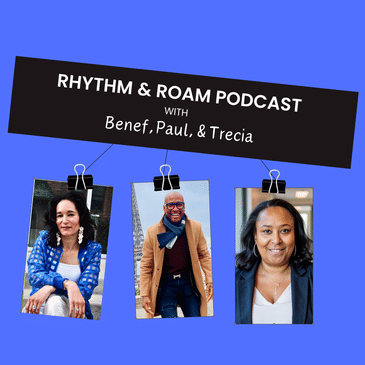



What if talking to a stranger could help bridge a divide? David Deighton, creator of Triptych Dialogue, joins Rhythm & Roam to explore travel, conceptual art, active listening, and how to find common ground in a polarized world. Visit RhythmAndRoam.com for more travel, culture, and meaningful conversation episodes.
[00:00:00] Back, your bags were on the move. Rhythm and Roam got nothing to lose. Culture clash from coast to coast. Misconceptions we chasing ghosts. And then I ask them questions and we get into it. And I do the weirdest thing that they don't expect. I just listen. Yeah. I just actively listen. And I tell them, you know what? You know, I'm that libtard that you're a commie that you don't like or whatever. I'm going to destroy your country or whatever.
[00:00:24] I'm in that country. I'm a U.S. citizen. And guess what? I'm angry, too. And that right there is my opening spot where they're like, oh, that's interesting. How would you describe the political system of the United States of America? It sucks. I mean, I don't have to describe it. It sucks. Like there isn't, unfortunately, political system in the United States. It's beyond out of control. I think it's unfortunate and it's sad. And the road we're going down is a road that we all learned about.
[00:00:53] And it's called 1930s Germany. So what word would you all use that would summarize all three of you in those comments? Chaos. Oh, that's chaos. Okay. Trisha, do you have one? I like desperation. I don't know. Desperation, yeah. I have hope. I have hope. I just, I continue to still have hope. Hello, everyone. And welcome back to another episode of Rhythm and Rome. My name is Ben F. Shat. And I am here with Paul and Trisha.
[00:01:19] And we are talking today to David and he is an extremely interesting individual with his form of art. He asks strangers three questions about the political environment in whatever country he's in. So it could be U.S., it could be France, it could be Mexico. And then he actively listens to the answers. And it's really very, very, very fascinating. We had, you're going to love this conversation. He asked us the three questions. So yes.
[00:01:47] And please, as always, show us some love with liking, subscribing, commenting, sharing with your friends and family and support what we're doing here. So come along with us on the journey. What's the best thing you've crossed off your bucket list? Oh, that's so tough. The first thing that popped to mind, and this is going to be weird. This coming from a guy that was like a zero population growth, no kids and everything, is having a kid. That just changed everything.
[00:02:17] Yeah. I'm not like I'm smiling or having a good time. Yeah, it's having a kid. That really changed me. Yeah, I was kind of a misanthropic person that didn't care much for humanity and stuff. And that really changed. And now I'm like teaching in schools, taking care of helping kids, all this stuff and talking to people. It's really brought me out of my shell. So thank you to my daughter. Yeah. That's the first thing that came to mind. Children are our greatest teachers. Yeah, that's great.
[00:02:47] So that's a very unique, actually, answer to the bucket list. But, you know, definitely fits in for sure. The next question is what song is most likely to get you on the dance floor? Ooh. Right now, I'm on my way to Morocco. So I really dig this music from Mali, Berber music. It has this like element of trance in it. Oh, yeah.
[00:03:10] And so if I find myself under a big sky and that music starts, you know, put your pods in or something, then I just start to dance. Yeah. Mm-hmm. Yeah. But there's so many different varieties, but that one would do it. Yeah. That's cool. I've started to rediscover Massive Attack. So I understand your space and your headspace and where you are right now. You know, Spying Glass and some of those other songs. So, yeah. Yeah. Segue to tell us about your type of art because it's not something I've encountered before.
[00:03:37] And how you use this to connect with strangers or people traveling. Yeah. Tell us about that. Yeah. It's pretty. Yeah. A lot of people say it's weird and unusual. I feel I'm in my seventh year on this project where I try to find ways to talk to strangers about taboo subjects. And so the questions are, here I am in the U.S., where do you meet strangers? Right? People have different political opinions. So I decided to go for the taboo subject of politics.
[00:04:07] I talk to strangers about the, I ask them non-confrontational political questions. Which is intriguing. Like, how can those two be? I was going to say, how is that possible? How is that possible? I think that's the most leading thing when I ask people that. They're like, oh, how is that possible? Yeah. I'll answer your three questions for sure. Yeah. And where is that in the western U.S.? It's difficult. Everybody's in a car. Commercial spaces are not open to First Amendment free speech areas.
[00:04:34] It's brought me by elimination to go to national parks. And there I go in those spaces. And people are in a natural environment. They don't expect to see this, like, conceptual art piece or whatever I bring to the space. And then I ask them questions and we get into it. And I do the weirdest thing that they don't expect. I just listen. Yeah. I just actively listen. And which is super hard because I get triggered. I mean, the first year I would get triggered for nothing. Like, oh, wow, that person said that.
[00:05:03] And then I have to correct that or whatever. So I've changed from that space of just thinking to try to be there for that person and listen in. Not try necessarily to understand, but just to find a bridge. Because often it's something I totally disagree with. That I can, you know, might be horrific, especially these days with the division in the country. Yeah. And I look for, in a nutshell, this is what happens. I ask them these questions. We listen in.
[00:05:31] And then I find something that I can connect with. And it's usually not a fact or opinion. It's like an emotion. So they're angry about this and that. And, you know, I'm like, I'm on the left for them. Although in France, I'm on the right, interestingly enough. Because the political spectrum is so far to the right in America to me. And so I find on an emotional level. So they're angry and I tell them, you know what? You know, I'm that libtard that you're a commie that you don't like or whatever. I'm going to destroy your country or whatever. In that country, I'm a U.S. citizen.
[00:06:01] And guess what? I'm angry too. And that right there is my opening spot where they're like, oh, that's interesting. And we build trust because I listened in. And then afterwards, we have a more less scripted conversation. Because I start with these three questions and it allows them to express themselves. I use gimmicks like I use a mic. And I say, that's my excuse. I'm out there trying to build stories for people so that they can go, you know what? We can talk about politics as a taboo subject. But we can talk about it.
[00:06:29] I met this guy over at the Grand Canyon or at Yellowstone. And he was talking about politics. It can be done. And so from that, they have a story they can take with them. And so for me, it's like a political act. And you could just change the United States. My question says, you know, the United States and it can change that for France. France is currently polarized as well. I was in Colombia a few weeks ago. Same deal. Same deal there. I mean, they have had 50 years of armed conflict. And they've been killing each other. And they're like, there's these things you don't talk about.
[00:06:59] So yet using that and active listening techniques has been, yeah, they could be applied there too. Bless your heart because it seems like everything that we do or talk or see or whatever has a political connotation to it. I mean, just being here in France or traveling overseas or whatever, anything you say has some undertone that has, which I'm just like, you're better than me on this.
[00:07:26] Because I've learned to, obviously, if someone is more vocal or whatever like that, I would literally not try to be a smart ass, but it comes out as a smart ass. But I'm just literally just saying, hey, I can't hear you if you're going to over speak me. And then they kind of go. Oh, yeah. That's where sometimes the confrontation go. The act of listening is truly very challenging to do.
[00:07:53] To know that you're getting triggered and to not jump in and say something and have to defend. Facial expressions. Or like make your point and make them understand. Like that's really not an easy thing to do. Yeah. So I applaud you on that. Like I have a hard time even doing that. It wasn't easy. I didn't say like I started like, hey, I know how to do this. It started out with me using the wrong questions, getting triggered all the time, having arguments and all that. But I got to say for the last six years, I haven't had a single argument.
[00:08:23] Well, I definitely need to understand that better with you. Because sometimes my facial expression, everything, it doesn't read well. So it then turns into arguments anyway because they know what I can, what you call it. But it leads down into the next question, David, on how we're talking about all this with both your travels. And domestically and internationally. What have you noticed about how people respond to you with this form of art? Well, they want to do it. They want to. Really? What concerns the questions?
[00:08:53] Most people want to answer them. They have something to say because they've been online all the time and their hearts and whatever and dislikes. And they're not really being heard. And in a sense, they know that there's an algorithm feeding them stuff and they're not getting the full story. Maybe they don't know what an echo chamber is, but they kind of like, well, you know, I'm getting fed this stuff. And so when somebody is in person, finally, they just download the whole thing. They just bring it out. They got to vomit out everything they have to say.
[00:09:23] And you're taking it. So that's the painful aspect of it is you're taking in a lot of the things that maybe they've never had a chance to say or they've refused to tell other people. But it's just to kind of like burst the bubble and get the conversation going. I mean, there's so many ways to do this. This is my way. I'm not saying it's the way, but it works for me. And it's something I can do not just at a national park.
[00:09:47] You know, it could happen when I'm at a grocery store or something that might be like a one-on-one conversation when I overhear something or when you're out there. But the thing is, is that we spend more time online than we do offline. So I want to kind of like get that balance, like have more interactions on meaningful conversations when we're offline. How did you get started? I mean, how did you get started in the societal work? Why was it important for you to start this? Well, it's not just this one project of listening to others.
[00:10:15] And it encompasses so many things. I think that what we're doing right now is actually part of the project. You know, all four of us were doing this art project and the listeners too. To me, art is everywhere and everything's political. So it's always kind of been there for me. But, you know, my dad, he's passed away, but he listened to early adopter to the radio Rush Limbaugh in the late 80s, like one of the first on the AM dial.
[00:10:43] Even early when I was a kid in Paris, I was listening to Soviet TASS radio. And then I can listen to Voice of America and kind of compare the two and go like, oh, they got two different stories. That's weird. And then seeing the country I'm living in get so pissed at one another for maybe good reasons, but not really. Yeah, in a sense. But they're not able to do anything. And then I was like, what's the point of hearing people's like, what's the point of voting? They're not getting involved. They don't have ways of doing it.
[00:11:10] And they don't know how to, you know, that they'll have an impact. So I wanted to try. That's how I got into this. You know, not just it's not 9-11 or the. The attack on the Capitol. They're, you know, that all that stuff is, you know, it's there. But it's now it's inflamed. So how do you like bring down the tension, especially if we enter a time of AI and things are going to get so much weirder. Oh, yeah.
[00:11:38] How do we talk to one another? And so, you know, that's why I enter the classroom and I substitute teach in the public schools because I want to see like how the kids are doing and they're on their phones. Like what are they doing? You know, and you're not supposed to be on your phones, but they are. And seeing a little bit about that. And I bring stories of philosophy to them so that they can like start thinking about what's an echo chamber and what's this. And they get classes in digital literacy. Okay, great. But that's that's a class. Let's make it fun. Right.
[00:12:09] And, you know, we have a role that we each have to play. And it's like things are accelerating in my view. So what do we do? And it's just to bring it down to the to like a foundation basis. Talk to people. How do you do it? Especially the ones that you don't want to have anything to do with. And should you? Yeah. But they say that the shit hits the fan. That's a horrible metaphor. Because it's like all over the place. I'd rather everything stays concentrated. Pick it up with a bag and throw it in the trash.
[00:12:39] But and because of that, there's like go out. You know, that's the only thing I found. I found this. I got to be it. I'll bring it all the way down to just let's not talk about facts or opinions. Let's just start. Let's see what a conversation would be like. A dialogue. Show how people how it can be done so they could do the same. And bring it back to their families, friends. Which, by the way, is harder than a stranger. So I invite people to talk to strangers first. Practice. You know, the skin in the games with your friends and family, the ones you're no longer speaking to. Yeah.
[00:13:09] David, I have a follow up question to that. What are you discovering about yourself? And I should I should ask just, you know, what I would say two things that you're discovering about others as you're discussing with them. And then how are you what are the two things that you feel that you've gained or the things that you've been able to kind of quantify within yourself? I think the second part, hopefully I've answered the transformational side and bring it down the anger.
[00:13:33] But what I found, and this is once again, it's not it's just my observations, is people, regardless of where they are, it's so interesting that they see their they hope they have hope. They want cohesion. Right. It might be on their lines because they know best. But they have they have vision of how the country should be. They might have a different platform of how they see it.
[00:13:59] But it's not there's not as much exclusion as we would as I thought there would be on an interpersonal level. Just because I was I'm a I'm a commie. I'm a socialist. All these things that they defined, that would be me. I tell them and then usually it goes like, oh, but you're not one of them. And I'm like, that's a win. Again, based on algorithm, right? That's based on the AI and algorithm, which is fascinating and also angry, anger me at the same time. Yeah. Yeah.
[00:14:28] It's like so big and it's growing. So like, what do you do? Right. And people are trying to disconnect or whatever. Who's disconnecting? That's what I want to know is like, who's you know, are they people that are disconnecting? Are they the same people that are ready to have the conversations? So maybe yes. So they got to go out, have a conversation, take on the pain just to show that it can be done. And, uh, and I'm getting some feedback, which is cool. Like I, I don't have a website, although my wife's building me one because like, David,
[00:14:58] you got to have a website. But I want this to be kind of like anonymous, not like this product I'm selling or whatever. But people like find me and they're like, oh, I know you. You're the guy that, that brings these books with the three questions in them. Or you're the guy that answers the question. And, uh, you know, I've been thinking about it and I've been having this conversation and the people in my church now and, and, and all these things are happening. And, uh, and I'm, I'm talking to my cousin that I no longer speak to, spoke to.
[00:15:25] And so when I hear these, these examples that just happen to come back to me, I'm like, okay, I'm good. This is good. That gives me the energy to keep it going. Yeah. Right. It just resonates with everyone. It just resonates with everyone. And do you think that's how like your work, is it propagates like grassroots style that that's going to be able to help the, like our country unite or like lessen the divide a little bit? Like, how do you think this, this is, this is going to work or like. I know, right. Yeah.
[00:15:55] To me, it's like a drop at a time. There's so much like in the ether that's just crap. And it's very, very hard to discern what's real and what's crap. And we're just like fed, you know, and some people aren't that great at realizing that they're being fed a product to create an emotion. Exactly. Or to create an opinion. Yeah. So there we are. There was a question in there somewhere. No, no, I get it. No, no, no. I totally get it. Right.
[00:16:25] And so where does it lead to? So, you know, I always thought I'd make it big. Right. But in the end, I realized that it doesn't, it's not that it's the, it's, I'm thinking small one person at a time that speaks to another and that's good enough. I can't, you know, I can't aim for anything big in this, this time of, you know, of, of online division that's being created. And so it's being in person and showing like those things could happen.
[00:16:51] Those encounters happen and they can be unpredictable and usually positive just to show that by example. How else, I'm up for ideas, but you know, I'm not like Greenpeace that's able to like bring down a big banner or whatever. But then afterwards that all goes online and that becomes like a media campaign. I'm not that person. Yeah. And also because of my, you know, it's, uh, it's not in me to do that. That, that takes, I'm good at just doing it for a period of time, having the exchange
[00:17:18] and then chilling out, like at a beach, that would be great. It's hard to find a beach with hardly anybody on it. Desert's good with me. I just like clear the mind and, and go with it. Uh, you know, it seems it's, you know, I thought it'd be fruitless, but it isn't. And it's, and it's changed me so much. I would love to have a little abbreviated session with you on your three questions. You have three of us. So it'd be interesting to see what our response would be. One, two, three. Okay.
[00:17:48] So the first question, Paul, is how would you describe, how would you describe the political system of the United States of America? It sucks. I mean, I don't have to describe it. It sucks. Like there isn't, unfortunately, political system in the United States. It's beyond out of control. And I'm not saying that because I'm for one party versus another party. I'm just saying no one has any more decency and no one respects anyone anymore.
[00:18:17] The rule of law is out of hand and it is slowly creeping into world politics. And I see it just living now currently in France where there's a lot of copycat and they're not copying any other countries like China or Russia or anywhere else. They're copying America. And I see it on the streets where people, there's lots of similarities of what's going on in
[00:18:42] America with what's currently going on in Europe, specifically in France or Germany or somewhere like this with, for example, the immigration, because that's the hot topic right now. They're, I mean, hell, London or England right now is trying to put a bill together to do something exactly like what America is doing right now. Even worse, their bill would, what would do. And the fact of speaking as a black man, racial profiling is, is out of control and is starting
[00:19:11] to be out of control here in France. It's that bad. So that's, I don't know if that's really an answer and it's not out of anger. It's just what I observe and I see. And I always say to myself, I'm 95% really good at observing my environment and my surroundings and people. I think it's unfortunate and it's sad. And the road we're going down is a road that we all learned about. And it's called 1930s Germany. Second question is, yeah, I said, no, no, no, I hear you.
[00:19:40] The second question is, is how would you describe your feelings or reactions to the current state of U.S. politics? Is this for me too? Or is somebody? No, I guess we're going to do, who's doing next? Benef or? Oh, okay. Patricia? Okay. So how would I describe my feelings? Or reactions to the current state of U.S. politics? It's like a deep sadness that can be overwhelming at times. I, when I do read the news or I'll, I'll watch something, I usually am more prone to reading
[00:20:09] because it seems less emotional if I read it myself. And I actually read a lot of like French version of what they say about us, but I just get, I get so angry. And then I get really, really sad that we're in the state that we're in and that there's so much like suffering and I don't know what to do about it. So I have that feeling of like, cause I too am not a person that's going to go out and like parade the streets and knock on people's doors. Like that's just not who I am. It's not my personality.
[00:20:38] So I'm like, I start to feel if I spend too much time in the news and I'm like hopeless and I don't want to be that person. So then I'm like ostriching and not watching any news. And like Paul's like, you don't, you need to be aware. And I'm like, yes, but I need to find the balance of being aware versus being like a depressed mess or angry. Like, I don't want to spend my days angry. Like who the fuck wants to be angry all the time? Like that doesn't help me at all. That makes me unhealthy mentally.
[00:21:07] And then it like goes to physical unhealth. Yeah. Like how can I find that balance? Cause I'm, it's, it's horrible. I'll watch, you know, I'm like, God damn it. Another fucking shooting, you know? And then I'm angry and then I'm sad. And then I'm now I'm, you know, reading a funny book or watching something to just try to not, I, yeah. So it's like deep sadness, anger, then sadness. And then like, I don't know what to do. And the third question is kind of a game.
[00:21:37] You're going to finish the sentence. Politics in the United States is very, very bipolar. And in the sense where kind of feeding off certainly what Benef is speaking on in one moment, you're, you're feeling rage. In my case, I try to base what we, what, what's going on in history. So I'm drawn towards folks that are bringing not only the news, but also bringing it to
[00:22:05] an historical context so that the basis of understanding is more, is more rooted in history or more rooted in, in fact than it is in, in propaganda. So that's what gives me the balance. And I still see the hope in people that do want to make a change. So. Cool. So those are our three questions. I've never had it. Usually, you know, it's one person. So there's a progress as you move along. But you guys are friends.
[00:22:33] So you've had these conversations before, probably, I imagine. And at the end, I, you know, I asked people to give me one word that kind of brings it all together. So what word would you all use that would summarize all three of you in those comments? Chaos. Oh, that's chaos. Okay. Trisha, do you have one? I like desperation. I don't know. Desperation. Yeah. I have hope. I have hope. I just, I continue to still have hope. Yeah. So there we are. We have three, three different words.
[00:23:01] And those words are going to change as you think about them. Right. Does it have, you know, the meaning of them and then where, where, where that takes you. Yeah. And that, that's part of your own personal transformational aspect. Yeah. Yeah. Right. So that's all good. And if you try it with somebody, somebody else, and because you've done it today, try it with somebody, try to try it with somebody else. See what, see what happens. Might not work for you. Right. At all. But it's something. Right.
[00:23:26] And I got to say that all three of you are already doing a podcast. And that right there, regardless of the subject, it's bridging. It's bridging. All right. And it's different. You know, it's like, although, you know, we're on phones and it's digital. This is very different. These, these conversations, you know, they're, at least we have two of the senses here. We have, you know, the visual in the auditory and for some, just the auditory, but they can imagine and created a story regardless.
[00:23:56] That right there is to me is also a political action, right? Is bridging to others. So that is an action that, that you, that you're all doing. So even if you feel hopeless, right. And that there's chaos or whatever you're, you're creating hope. Because you're doing just that right now. I'm not just saying that, throwing it out in the air. It's, it's real. I mean, that's what podcasts like this do. Yeah. That was awesome. And David has been wonderful.
[00:24:24] I want to just thank him. I hope you guys also enjoyed this episode too. But of course, you know, like subscribe, or if you can assist us with buy me a coffee so we can actually continue to do and bring you great episodes like we've been always doing. And don't forget, we have this little pocket guide that we always do.
[00:24:46] And just, you know, go to our website at www.rhythmandroam and you can learn a lot more about it. Trust me, it will help you out with planning your next adventure travel or anything else that you have. So until then, guys, this was awesome. Thank you again for being such great partners and co-hosts. And until then, see you guys next time. Deuces. Bye.