


On this episode of Rhythm & Roam, we sit down with Australian hiker, writer, and educator Belinda Coker, who spends up to eight months a year walking long-distance trails across regions and countries. She shares how moving slowly through towns and villages reshapes her view of culture, identity, and community, and how house-sitting lets her "live inside" a place rather than pass through. We also dig into midlife adventure, planning months of solo hikes, and what it means to "meet culture at its own pace" as a lipedema warrior on the trail.
Visit RhythmAndRoam.com
[00:00:00] Back your bags were on the move Rhythm and Roam got nothing to lose Culture clash from coast to coast Misconceptions we chasing ghosts When I was about 55 I kind of looked in the mirror and I thought I am so not happy. I was burnt out, I was stressed, I was overweight, I was unfit
[00:00:20] And I saw this bear come out over the trail, bound over the trail in front of me and the way that he just bounded over and his head, the fur just went up and down and he looked like Fabio and I was just like, oh my gosh, it's a bear. So my kids got this message from me saying, oh my God, I've just seen a bear and then absolute radio silence for three days.
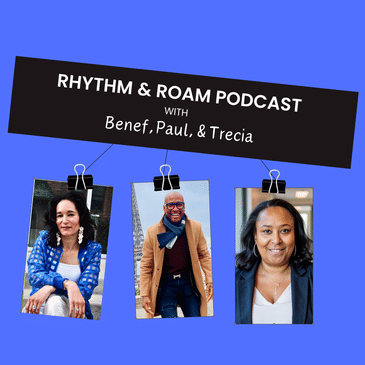
[00:00:43] We spend probably about a fifth of what we used to when we were living in suburbia in a house. And we just bind to impress people we don't really like. I think you hit it on the spot with the last word you said, impressing people, there's no need to impress. Hi everyone and welcome back to Rhythm and Roam podcast. My name is Benef Shea and I'm here with Paul and Trecia.
[00:01:09] We are so excited to welcome Belinda today and Belinda is a hiker. And when we mean hiker, we mean like eight months out of the year, she is hiking or house sitting. And so we're talking to her about how does she plan for her hikes? What are the logistics like? The house sitting. She has a lot of great information on both of those things and just the adventures that she's had hiking all over the world. What was your most memorable wildlife experience?
[00:01:38] When I saw my first bear in North America, I think that really, that really was. I mean, coming from Australia, we've got, you know, the 10 most venomous snakes in the world and spiders and cool wombats and kangaroos and all this kind of thing. And then I, I was hiking the Tahoe Rim trail and I was on the, I was on the, I was, I was, you know, my phone was in, was in my pocket, my front top pocket.
[00:02:05] And I saw this bear come out over the trail, bound over the trail in front of me. And the way that he just bounded over and his head, the fur just went up and down and he looked like Fabio. And I was just like, Oh my gosh, it's a bear. And it was just the most amazing thing I've ever seen. And I texted my kids and I said, Oh my gosh, I've just seen a bear.
[00:02:26] And then I kept walking and I would have gone into what's known as the wilderness, which is a, the west hand coast of the Tahoe Lake. So it's on the, on the west, on the western side of it. And so I went out of reception for about three days. So my kids got this message from me saying, Oh my God, I've just seen a bear. And then absolute radio silence for three days. And I went, Oh my God, mom. No.
[00:02:57] But yeah. Look at me. Yeah. But that was the most magical thing. And I just, and I just had a new pocket, a shoulder pocket. And I couldn't get my phone out fast enough to take a photo. And it was just like, wow. That was a wow moment for me. Yeah. So if you had to, if you had to title a memoir, if you had to tie it all up on just to this point in your life, what would you, what would you title it?
[00:03:22] What would you title your, what would be that, that, I guess, encapsuled title of what you've done thus far in your life? That's a, that's a really, that's a difficult one. I suppose adventure would have to be in it. But I would also, I mean, I've, I've, you know, I've had some very stressful sort of periods in my life where, you know, back in civilizations, so to speak, in suburbia, you know, married, the kids, the whole, the whole shebang.
[00:03:49] And so I have actually been habitualized, I should say for a better word, you know, and, and done the same thing that, you know, every, you know, that I suppose people with a normal life who aren't nomadic like I am done that kind of thing. So, and I know that the reason why I started to live the life that I, that I do now is one day I looked in the mirror when I was 55.
[00:04:18] I turned 60 on the trail late last year. So when I was about 55, I kind of looked in the mirror and I thought, I am so not happy. I was burnt out. I was stressed. I was overweight. I was unfit. I was, you know, and I was, I'm probably putting myself down a lot more than, you know, than I actually should. But I wasn't at a good point in my life. And that's when I started, decided to go out and go on a hike. So I did, I've done a lot of hiking.
[00:04:46] I know this isn't really answering your question, but I'm getting there. So I've done a lot of hiking, you know, when I was in high school and university and I knew that that would put me in my happy place. And it was just that finding something that I love and also getting my confidence back and doing it through adventure is how I got to where I am now. And it was, it has been quite a journey.
[00:05:15] It's not like I'm just this amazing adventurer and I'm going to suddenly decide to go off and hike around the world. It really was a process of getting myself out of a rut. So if I was to write a memoir, it would have the word adventure in it, probably. It would also have the word confidence in it. I don't know what the other words would be though at this point in time. Yeah. Okay. So let's, let's get down to the meat of it because like you do a lot of hiking.
[00:05:42] Um, and when you're hiking, you're on foot. So things are going slower. And I, and I love what you had said about that. You're, you're meeting, um, it's what happens when you meet culture at its own pace instead of on your terms. And so I just wanted to explain a little bit more about how you do that with hiking or how that comes about. Okay. So it's really incredible when you are actually on a trail in somewhere in the world and it could be anywhere.
[00:06:08] It could be Tahirun Trail in, in the, in, in the USA or the Greenland Trail or any of the Camino, this Camino de Santiago, any of the trails all over the world. They're either, a lot of them are based on old indigenous routes or they're based on old trade routes, especially in Europe. Most of the old hikes in Europe are based on, on old trade routes.
[00:06:33] And then you've got, uh, uh, when governments or, or bodies like national park bodies in whichever country you're referring to have put a trail together, wanting to showcase the best that the country has to offer. And a good example of that would be the Pukkawi Trail in Sri Lanka has got, you know, runs through all the, all the tea, all the tea hills and, um, you know, through little villages.
[00:06:59] The thing about when you're hiking from along a trail, it doesn't matter how long it is. It can just be four days, two days, three days, two weeks, you know, or, or a month or whatever you are hiking. You're, you, if you are passing through civilization, it's usually small villages where normal tourists don't go to. And so you, you really are like seeing life, life as it, as it really is in that country.
[00:07:27] There's no, you're not in a five-star hotel. You're not on a cruise ship. You're not, you know, walking from museum to museum to art, from art gallery to art gallery. And, you know, saying, oh yes, lovely museum, lovely art gallery. Yes. Lovely cafe, lovely restaurant. And doing this, the stuff that most people do on holiday, you really are experiencing a country at its grassroots. I really, I really like that. So it's just like slowing things down.
[00:07:55] There's probably not, there's not a ton of people, not a ton of tourists walking these trails. So you're not. Yeah. You know, one of the, the things that I wanted to find out, you mentioned, or you do hiking over eight months in the year. So that means that you probably hit some winter months in there too as well.
[00:08:14] I'm just curious, you know, how do you plan and, and how do you figure out which hiking trail would be the one to go to today or, you know, next month or something like this? Like, how do you plan it? I assume season, you know, played a role in that. Absolutely. So we have, we, we do house sitting in between and in between hikes and we have a regular house sitting gig now, which is quarterly.
[00:08:43] And so it's March, June, September and December. And, and sometimes it's only three times a year, but whatever it's, it's fairly standard. So we know that in between and between the month where we're house sitting, we can hike. And so I've got a bucket list of hikes. It's probably, it's, it's as long as it's infinite. But you try to stay away from winter. Do you try to stay away from the cold, cold climates first or?
[00:09:11] No, because don't forget down under and, and South America are nice as hot and sunny. But I, yeah, I did get, my partner actually went down to New Zealand the last January, January just gone. And that was just perfect hiking weather down there.
[00:09:31] I went to the Canary Islands, which are a group of seven islands owned by the autonomous islands, but they're owned by Spain and just off the coast of Western Sahara. So technically they're supposed to be really hot, but they had a really cold, cold spell. Yeah. And I ended up, I ended up with hypothermia and actually needed, and I, that's why I bailed. And we're going back in October to do that.
[00:09:58] But there's certain, there's certain hikes, if I needed to put all the hikes on my infinite list that I have and put them into seasons, they, that there'll be four groups. So there's spring, there's spring, autumn, there's summer where all that you do all the alpine hikes, spring and spring and autumn or spring and fall where we're doing all the sort of Mediterranean hikes are great that time. This spring, and we always have a plan B as well.
[00:10:24] So we say, right, okay, our plan A this time was actually the Jordan Trail. Jordan's a bit dodgy at the moment. So then we sort of changed plan and said, right, okay, well now we can go to Greece because that was, it was one of the things on our list. So we have, we have several sort of hikes that we can go, right, okay, just as long as they're kind of in the same area. Yeah. That's, that's, that's interesting.
[00:10:51] But there's one, I just wanted one follow up because I think it's important is when it comes to what would you say for average cost for if someone wanted to like go like hiking and stuff like, like, would you, is it just more of airfare if it's somewhere away? Right. Yeah. And most of the time, I'm assuming part of your hike, you're probably camping out to as well because of how long it is and stuff like this too as well.
[00:11:19] So would you say that the heaviest spend would be, you know, the transportation piece of it? Or the gear. Or the gear? Yes. Well, the gear too. But I mean, okay, just quickly on the gear, this is, you know, I see a lot of people, oh my God, the tent's $400. I have had a four, used $400 tent continuously for over four years. So that's like $100 per year.
[00:11:44] And I've spent way more than, you know, probably 50 nights in it per, you know, per year. And if you sort of divide it all up, the cost is actually pretty, it's not a big deal, especially when you're talking about how, you know, I say to people, how much do you normally spend on hotels? Right. Oh, you know, $75, $100, you know. I mean, you can hardly get anything for $75 or $100 now. Yeah. Not a hotel. You want to stay in. Yeah. Yeah.
[00:12:14] Exactly. Well, guest houses here in Europe, you can. So it's pretty good. But, you know, so, so, you know, when you put into perspective like that, you know, a tent is your number one shelter. It's your most important part of your kit and it could actually save your life as well. So I think that's really important. And, you know, there's no reason why you can't buy cheap to start off with and then slowly replace all of your gear with quality gear, you know, each year or something, a piece each year.
[00:12:41] So, you know, there's a lot, there's a lot of cheaper gear that will suffice. So, Belinda, you mentioned earlier the fact that you do have a kind of a, I guess, a yearly house-sitting job or gig that you do. And how do you incorporate that with your hiking trip and, or your hiking trips? And basically, how does it allow you to experience the cultures and the people? How is that, how does that factor into what you do?
[00:13:07] Okay, so this, the regular house-sitting gig that we've got is actually quite, it's quite recent. And before then, we were just finding house-sits as, as we needed to in between hikes. And then we started, we did a couple of hikes for this particular, it's in this beautiful old 300-year-old converted mill. Well, the conversion isn't 300 years old. The conversion's very recent.
[00:13:33] But the mill, it's got stone walls, like literally, my hands are, for anyone who's not watching, my hands are like beyond the computer. Probably, the walls are about two foot thick. I mean, it's amazing. And so that's up in Scotland.
[00:13:51] And so we, we actually started to do that and we thought, right, okay, well, that's a really good, that's, that's really good for us to be able to just, you know, settle ourselves in between hikes, catch up on my writing, catch up on our health, get all our gear sorted. All the sorts of things that you sort of need to do because my partner's from New Zealand as well. I was born in New Zealand, but I lived most of my, most of my adult life in Australia.
[00:14:18] So we don't have a home base here and it's kind of given us a bit of a home base. Just to, just to give you the background story, we are actually based up in the Northern Hemisphere until, until grandparenthood beckons us back down under. So, yes, so, and that could be, you know, it could be three years, it could be five years, it could be a year. You know, you never know, you never know. So, so we're trying to make the most of our life, our life as we can.
[00:14:47] And so basing ourselves up in the Northern Hemisphere was something that we really wanted to do. And we love Scotland. So that's why we're, you know, we're based in Scotland. But we have also done other house sets. We've done Spain, Germany, France, America, Canada. And we, and it's amazing because you go to live in somebody's house in a, in a, it might be in a village or it might be in a city.
[00:15:14] And we were right in the centre of Barcelona for probably, I think it was about, it was about two weeks. And that was incredible. You know, you, you, you, you're able to not only experience the culture of a particular country or destination where you are, but you're, you're able to sort of shop where local shop. You're able to sort of talk with other locals down at the, at the dog park.
[00:15:40] You know, if you're taking a dog for a walk, you're able to sort of be in a house that belongs to somebody who is not from the same culture as you. And that's pretty cool as well, you know, because things, things around slightly differently and that's, and it's really neat. So yeah. So that's, that's kind of where, when I say, when it's able to experience culture in such a way that is, it is, it's totally immersive.
[00:16:06] It really is because you are literally put yourself in another, another town in another country and where you might not even speak the language. I mean, I could not find one other English speaker in the little village in Germany near the Black Forest. There was not one other English speaker and I didn't speak. And there was, there was no wifi on the streets as well. It was this little village and there was one, there wasn't a shop.
[00:16:33] Oh yes, there was a shop, which was only open twice a week, but there was a pub and nobody spoke, nobody spoke English in the whole pub. And I was just like, it was hilarious, but it was fun. It was fun. And everyone was lovely, lovely. Yeah. Well, so how were you finding these or how did you find these gigs? Or because I know there's a few websites for house sitting, but like, how did you choose which one? And I wouldn't want to, I mean, like, how do you know that the people aren't sketchy? How do they know that the house sitter isn't sketchy?
[00:17:03] You know, that's where I'm like. You could tell we're talking from an American standpoint. Yeah. Some of my best house sits have actually been in America. Yeah. America was fantastic for it. They don't have cameras everywhere watching you. That's the most important part. You don't even know that. You're not allowed cameras. Yeah, but no one is going to tell you that they're hiding a camera either.
[00:17:28] So I do use a site called Trusted House Sitters, but I also have some resources on my site, the House Sitting Collective, where I have some of the resources, how you can find them and all sorts of things. And we always have a video call first. So we've got great references. So, you know, we've kind of got stuff, five-star reviews. We've got a whole bunch of them with, you know, dozens and dozens of house sits.
[00:17:58] But one of the main things is that, say, with Trusted House Sitters, you get reviewed. So they know that, you know, they can read your reviews. But you can also review the host as well. So the host gets reviewed. Okay. You know, and sometimes there are a few red flags.
[00:18:16] So if somebody's sort of, you know, often sort of has unrealistic expectations or anything like that, quite often that'll be documented and you can kind of read about that. Can I just say one other thing? We often get asked, how can we afford to live the lifestyle that we do? My partner and I are retired. We've taken early retirement.
[00:18:42] So, and this is actually a very interesting question because our life now involves hiking around the world and just basic and having a ball, enjoying the golden years of our life. Right? Awesome. We spend probably about a fifth of what we used to when we were living in suburbia in a house. So the house sitting is free. We live frugally.
[00:19:12] I used to fly in the pointy part of the plane. You know, now everything is pared down to the absolute basics and we get more joy out of being in a tent and waking up to a beautiful sunrise and cooking our own meal and maybe taking a bottle of wine on the hike if it's a short hike as well. We get more enjoyment out of the simple things in life. We tented a lot.
[00:19:37] That takes away another really expensive accommodation cost as well. So that is how we do it. We just live frugally and we don't need to spend loads of money on all sorts of things that we don't really need and we just bind to impress people we don't really like. I think you hit it on the spot with the last word you said. Impressing people. There's no need to impress. Yeah. This has been really, really interesting.
[00:20:05] You know, first of all, just the fact that you have made this as part of your life as long as you have. And the joy that you get out of it and the clarity and everything that goes along with that. But then also being able to, you know, certainly put on that piece of, you know, the house sitting and being able to immerse yourself in the culture. Yeah. In other places. So you have, you have a lot of knowledge in that. And we thank you for sharing that with us. Yeah.
[00:20:33] Well, and your website is house sitting collective.com. That's correct. So the house, it's not the, it's called the house sitting collective. Oh, the house. No, no. Yeah. The website is just house sitting collective. And then my hiking website is soul treader. So soul treader. I have all the guides, not all the guides because I'm a little bit behind in writing them, but I've got guides on the hikes that I've done.
[00:20:59] I've got really informative guides on what to wear, what to eat, first aid, wilderness first aid. So first aid, you know, all sorts of things. How to, what the difference between American, Australian snakes. I've got a whole article about that if you're interested. There you go, Paul. Well, you do have a beautiful website. You do have a beautiful website. Because it's very, very photogenic. Can I say that? Yeah. Yeah. Yeah, yeah.
[00:21:26] Actually, also I have something about soul treader as well. So, and this is, this is a free resource on soul treader. It's a book called Hike It Right. And it's health and safety on the trail. It's free. It's just all the good health and safety, the safety and health aspects that you have to watch out for when you're, or you have to be, that you should be knowledgeable about when you go off on a hike.
[00:21:52] And that can be anything from, you know, hypothermia to, you know, dehydration, all that sort of thing. And so, you know, if you are interested in the, and the, with the great outdoors, you know, it's, it's a great resource. It's doesn't cost you anything. And, you know, it's my gift. So, but yes, I, I do have the house sitting collective, which is a training, training module on how to, how to house it.
[00:22:20] Now, it's not just how to house it. It's how to write your, how to write your, your profile, how to use power words, how to, you know, everything that you need to know about house sitting is in there in the foundation course. And then I've got a small sort of, sort of smaller courses just on writing your profile. And I have a 10% discount for all listeners. And the code is HSTravel.
[00:22:49] So it's H for house, S for city, and then travel. Excellent. Thank you. Well, you guys just hit the lottery today to our listeners here. So be sure to use the code to get more information because this is, this is really good stuff. Yeah. Hey, thank you for sticking around till the end.
[00:23:10] And I hope you guys were very excited about learning more from Belinda about, you know, traveling, hiking and doing it the, I'm going to say the unorthodox way versus plane travel and all that other stuff. This was very insightful and great information as usual. Please like subscribe. And we do a newsletter every 30 days. We provide you with a newsletter.
[00:23:39] All you have to do is go to our website at www.rhythmandroam.com and just scroll all the way down and just put your awesome email address. And I promise you, we have some great stuff that comes out of that newsletter on a monthly basis. We want to thank you for continuing to support us in what we're doing. And if you really like what we're doing, please do consider supporting us at buymeacoffee.com.
[00:24:08] As well as if you have other great ideas or topics that you would like us to discuss, we would really love to hear from you and so on. And last but not least, we just launched a beautiful travel app and would love for you to also go on our website and you can have a look in our tab that says app. And it's for Rhythm, Rhythm, Rome, Trips. It's a travel planner. Rhythmandroam.com. And we would love for you to hear. Thanks again.
[00:24:38] Pack your bags, we're on the move. Rhythm and Rome got coached a class from coast to coast. Misconceptions we chasing ghosts.