
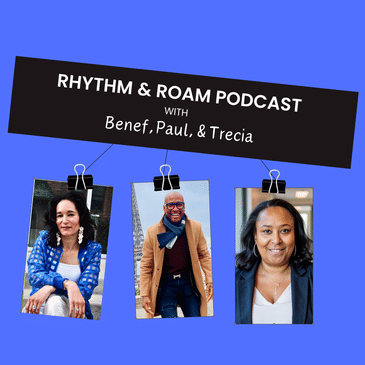



Step into a crowded Irish pub, the fiddle starts, the pints are flowing… and you're wondering if it's okay to clap, sing, or join in. In this episode of Rhythm & Roam, Benef, Paul, and Trecia sit down with Irish fiddle player, podcaster, author, educator, tour guide, and arts manager, Tara Connaghan, to unpack the unspoken etiquette of traditional Irish music sessions. If you've ever dreamed of traveling to Ireland, joining a session, or just walking into a new environment without second-guessing yourself, this conversation is your guide. Visit RhythmAndRoam.com for more with Benefsheh, Paul, & Trecia.
[00:00:02] Rhythm and Roam, coach to clash from coast to coast. Misconceptions we chasing ghosts. Jumping and start doing it. Yeah, yeah. Like I bought a Byron yesterday, can I join your session? You know, it was like, okay, do you know anything about Irish music? Yeah. Wow. Actually the word share that you've just said is the acronym that I use for this system that I teach people.
[00:00:27] Yeah, he said because you're gonna remember the time you came to Ireland and you didn't dance. I was like, whoa. Very no. Like just because he was afraid or there was that fear. Yeah. Yeah. And he wouldn't remember the time you came to Ireland and you didn't dance. It'd be just like another, you know, another place you went to visit. Hello, greetings and welcome to another episode of Rhythm and Roam podcast. I'm one of your co-hosts, Ben F. Shett, and I'm here with Paul and Trisha. Hello.
[00:00:53] Hello. And yeah, we have such a fun guest today, Tara Conahan. And she is from Donegal, Ireland. So the northern part of Ireland, but not Northern Ireland, the northern part of Ireland. And we're talking with her about Irish music and the etiquette surrounding Irish music traditional sessions. So people that are musicians want to play, but you know, there's a protocol to joining in on these sessions.
[00:01:20] And we talked to her about this and so many other things and come and join us. What song makes you feel the most nostalgic? There is a tune. And I think it used to have words. It's called Maggie Picky. And it is something that it's something that I've heard like going back way, way, way, way, way back to my childhood.
[00:01:42] I think it's probably one of my earliest memories of that tune. And it just there was an intrigue about it because I think you used to maybe have they used to put two pokers from the fire on the floor and dance around it. And it was a specific dance to a specific tune. And so I this is something very homely about that tune and very familiar. Yeah. I didn't catch the name. What is it? It's called, well, in this area, it's called Maggie Pickin and the Maggie Pickin's dance.
[00:02:12] But it's also known as the Maggie Picky. Maggie Picky. OK. It's from this kind of area in the northwest of Ireland. And it was supposedly it there is, I think, notations of it. It was heard back in the 1700s. People are those people kind of exploring Ireland and they heard this tune. And it said that it would drive the locals crazy. OK, so the final question, what would be your personal theme song or like if you were walking on a stage or like walk on song?
[00:02:41] I'm going to have to create one. Oh, wow. God save us. I mean, we'd obviously have to be Irish music. For sure. We thought that. Yeah. And it would have to be me as well. I mean, I could be promoting somebody else. So, yeah, it would have to be me. So you would create your own. That's that's really it. Promote yourself. Heck yeah. Yeah. Would it be like a like a like a traditional Irish type of song or would you more contemporary? Yeah, it would be more traditional. I'm more of a traditional player. Yeah. Yeah.
[00:03:10] So with all that said, can you reach up? I'm going to reach it back around and ask you to explain what does it mean when you were talking about, you know, the etiquette around traditional Irish session music session. Music sessions. Okay. So, yeah, I have a podcast on on Irish music session etiquette and the etiquette in Irish music sessions. And so what I was kind of as well, the reason I started it was because I had students. I teach a lot of adult musicians who are learning to play the fiddle.
[00:03:39] That's what I play. So I said that I was maybe like I was always kind of helping them with performance anxiety or that's what I thought I was kind of helping them with. But it turned out that maybe I was more helping them with the etiquette, the rules of joining a session because that's what they were anxious about. So I was thinking about writing a book on session. No, on performance anxiety just so I could help other adults. And so one of my students is a retired doctor.
[00:04:06] And I asked him if he would be my medical advisor for this for this book project. And he said, Oh, absolutely. I'd love to. But, you know, he said, Do you want to be better if you do a book on session etiquette? And I said, Absolutely no way would I go near that vile subject. It's vile. It's horrible. Oh God, no way. And, you know, I said, No way. And he just kept probing a couple of times. He was like, You know, but if I had a book that I could, you know, read all the etiquette and what I'm supposed to do and all the rules, then I would, you know,
[00:04:36] it would have saved me 20 years of, you know, toil and trouble and that I, you know, I would have all these faux pas that I've done in sessions and it would have stopped. It would have prevented me from doing all of that. So eventually I kind of realized that actually the reason why people, I was kind of helping people with the performance anxiety wasn't, it wasn't just, it was being anxious. It was anxious because they didn't know the rules or then, you know, the etiquette of joining something that is new to them. So that's kind of what I've been doing for the last year.
[00:05:05] And it's all, it's really about joining something that exists before you. So that could be anything. I mean, that could be going into a job where there's an, there's a etiquette around like there's a culture there already. I think we kind of call it culture as well, you know, so a culture exists before you arrive and you kind of, you go in there and rather than go, right, well, I'm here. Now you all, you beat to my drum because I'm here. You normally kind of go in with a bit of respect and you go, right, I'm going to try and read the room, read the lay of the land. What am I supposed to do?
[00:05:34] What is expected of me? What is, you know, and that's the same with the session, but we kind of forget that that's, because it's just, I suppose, new. Everything's new. Maybe people might have taken up the instrument in the first place. New. They might not have ever played before. It's all these new tunes. There's all these new people that they've met in a session. There's just so much new and they forget. There's just respect that you need. Yeah. In order to. And so is it like people in a, like somewhere are already playing and another musician wants to come in and play? Is that what you mean? That's kind of.
[00:06:01] Is it like an improv type of thing where they're just picking up and sitting down to play? It's kind of like an improv. Yes. No, the improv happens normally when you know the music well, so you wouldn't improv over it if you don't know the music. So I know some other kind of maybe genres you improv over it, even if you don't really know what kind of, it's kind of more tolerated. Whereas here it's not really, it's very melodic focused. So it's about a tune and that everybody's playing the same tune.
[00:06:30] And then, and so there is a compliment as well, but there's no different layers of harmony to it. It's a tune and we're all playing the melody. We're all playing ever so slightly different melodies at the same time, but they all kind of work together. So, yeah. Interesting. No, that's, that's, thank you for that because I was very curious on etiquette because everything has etiquette. Yeah. Driving on the roads. Mm-hmm. Everything. Yeah. Yeah. Go to the dentist. Everything is an etiquette. And it varies by country, the etiquette, right?
[00:07:00] But anyone can, if you can play an instrument. We have any etiquette in America. If you can play an instrument or anybody can play an instrument, they can jump in, but there's a certain way to be able to do this. They have to know the music though, right? Like I don't know. I mean, like if you can play music, you can. Well, I mean, I would say it would be just kind of disrespectful to jump in if you have never heard Irish music before. Mm-hmm. Because then you're just like, I'm going to impose something on you that isn't on this. Makes sense. Yeah. Yeah.
[00:07:30] So it's kind of like, I need to have respect and listen first. And then if I think maybe it would be something that I could add to it. But yeah, I would, I would, I would usually kind of, if you want to, if you want to rub people up the wrong way, that's definitely the way to do it. Jump in and start doing it. Yeah. Jump in and start doing it. Yeah. Like I bought a Byron yesterday. Can I join your session? You know, it was like, okay, do you know anything about Irish music? Wow. Like that happens.
[00:07:58] I think because people think if they're musicians, they can just jump in and do anything. Well, I mean, there's a certain amount. I would imagine if you are already a musician from a different genre, like maybe jazz or classical or, you know, another folk tradition around the world, there is a bit more grace there, but you have to have, you have to almost do different legwork before you go in. Yeah. I don't know if you know, if you have that term legwork as well. Yeah, sure.
[00:08:51] Yeah. That's your party piece done kind of thing rather than joining along because it's, it's just not, it's not a music that has layers. Gotcha. So, you know, what, what, what would be there? How could they contribute to it if they, if they don't already know the melody and they're not playing it? Well, maybe they could accompany me, but they accompany it if they were a guitar player or something. But I'm just thinking if I were a fiddle player or a violinist from a different tradition and I didn't know the tune, then, you know, what would I do?
[00:09:21] I mean, I'm limited to what I can do. I'm limited to what I can do. I'm limited to what I can do. You know, like I'm someone that plays multiple instruments and, and knows their craft, like a prince, for example. Right? Who can just, you know, listen and then say, yeah, I can do this and then jump in. I don't know if they can do that. That's like you said, you don't think. It's tough. Yeah, I would imagine it is only on certain circumstances or in certain circumstances when you're really close to musicians and you know the musicians well, they're your friends.
[00:09:48] And they say, let's have a moment where, you know, let's have a kind of a get together where you, you do what you want, you know, you try and add to this music how you see fit. It wouldn't be for a normal session in a pub. It's just going and you just walk in and you don't know anybody. Yeah, it's just not, it's not respectful. Yeah, it'd be very awkward. I don't know anyone. I'm like, I'm going to play. No, yeah. No, people do that a lot. I mean, in respect, people do that a lot in jazz.
[00:10:15] So you go to New Orleans, people do that a lot in New Orleans. Yeah, yeah. So Trisha, your son. But they're probably jazz musicians. Yeah. Yeah. Exactly. We do this in Ireland as well, where we go, like I could go down to, I'm in the northwest of the country, so I could go down to the southwest of the country, the southeast of the country and jump in and just say, how's it going? Yeah. I've brought my fiddle. I'm from Donegal, but I'd love to play a few tunes or just mind if I sit in. Brilliant. Yeah. Just sit in and play away.
[00:10:45] But I'm still playing the melody that they're playing. So we're still playing the same thing. And like jazz, they'll be still, it's kind of, there's in every tradition, there's a, there's kind of a boundary. Mm-hmm. That's one of the boundaries for Irish music because it's just melody. It's very melody focused. So that's one of our boundaries kind of, yeah, you can push past it a little bit, but only if you're really friendly with the people who you're doing it with. Thank you for that. So Tara, I kind of want to speak on kind of the different plane here a little bit.
[00:11:14] We've, we've spoken a lot about being the musician and my son is a musician actually. He's classically trained and he is a musician in Denver and he actually does play jazz music. And really a kind of big band. So very used to being in a, in an environment with a lot of musicians, you know, accompanying and playing many different, playing melody. Yes. But playing very different notes at the same time. But me being an active listener, you talked, you talked about that and kind of mentioned that a little bit before.
[00:11:43] What exactly is the role of the listener? Irish, Irish music session. What say myself being an American coming in on in a pub and listening, what would be my role in that? It depends, I suppose, which session you go to. It all depends on the session that happens, happens to be happening in front of you and who is in that session. If there's somebody maybe that's a bit giddy, you know, on the night, they happen to be like up for anything.
[00:12:12] This is, we would have a session on a Wednesday night here during the summer. And that's what we, it's like our giddiness. We just let our child, our inner child children out to play. And so it's like anybody that comes into that pub is not a target, but we're like, we're going to get them to join in on some description. You know, so like if they can dance or they can sing or they can do anything, they're going to participate. So that's what we kind of, because, you know, we're playing there every night. So you want something, or not every night, but every week or something.
[00:12:39] And you want, you need something to kind of stop you from being bored. So if you are engaging different people all the time, then that helps relieve the boredom. Not that music makes you bored, but just if you're playing with the exact same people, the exact same tunes all the time. Yeah. Yeah. That's why I don't particularly play in bands or in groups and tour of the world because I've done it for a couple of years and I got just bored silly.
[00:13:05] So, you know, I like sessions where you're free and it's just so much fun and it's all about fun. So now that could be the other side of the coin as well, where maybe the musicians have had a really tough week at work. This is just a blow off steam for themselves. They just want to play with their friends and they don't want to engage. That, you know, makes sense. That's needed too. So it just depends on the type of environment you happen to walk into. And it could be totally different the next night with the same musicians. Sure.
[00:13:33] It could even be totally different from the start of the night to the end of the night. It just depends on who walks in or it's all, it's all people based at the end of the day. It's not necessarily even the whole etiquette about skills. You know, it's not really skill based at all. It's really about people, about personalities and yeah, the social side of it. Yeah. So really it's about, it's about reading the room basically. So if you walked into, you know, a pub, you've got to read the room and see what's going on. Yeah, exactly.
[00:14:02] I had an episode in my podcast recently where somebody said, read the room. And I'd heard it a couple of times and said, right, we're going to focus in on what does that mean? What do you mean by reading the room? And she gave us such a brilliant, yeah, a brilliant definition of it for herself. Yeah. Yeah. That's good though. Well, because you do the podcast, do you do the podcast like weekly or biweekly or is it just sort of whenever? I wish I did it weekly.
[00:14:29] I actually do have lots of interviews weekly. Yes. Several interviews weekly. So I have, I started last July and I have 15 episodes up that I have released, but I have another, I just did my 57th recording of an interview today. So I have a huge background. Okay. Wow. That's awesome. A full year of weeks. Oh my God. That's perfect. That's perfect. And, and you have online courses too.
[00:14:57] I have a bit of online courses which I started recently. Yeah. So I want to like, so how do those, the, with the podcast and the online courses, like how do you help people navigate those unspoken rules when it comes to group spaces or shared spaces? Actually the word share that you've just said is, is the, the acronym that I use for, um, the system that I, I teach people. So this is for the summary of it.
[00:15:22] Um, you know, the, the background of, of, of Irish music and you know, it's kind of position in the world and in, and, and in different musics, you know, within, within globally, the music scene. Then there is H, which is kind of like the handbook, the kind of the do's and don'ts. Should you sit on that empty stool? Should you do this? Should you, how many times should you play that? Uh, should you start a tune? All those kind of nitty gritty kind of, um, questions.
[00:15:46] And then there's the A for awareness, your awareness, um, around about yourself and how you're, you're, you impact the room and how you impact others. And I think that's kind of the reading the room kind of scenario as well. And then other looking at others as well, the awareness of others and how they are impacting you and the session and the, the awareness of that music is bigger than all of us. We're all there just like a teamwork. And so that really is the teamwork kind of part of it. And then there's R for relationships.
[00:16:15] That's another kind of part of the teamwork, um, where you're relating to all those other people and relating to the bar staff relating to your instrument. And then there's the E, E is for excellence. That's the next phase where they go from, you know, the learning phase to the get in there and start playing. So, yeah. And I have a tour as well, or kind of like, would I call it a tour? I still don't know what to call it.
[00:16:36] It's like an immersion week or a five days where people kind of come to this, this area and they get taught the kind of the different bits and pieces, um, cultural immersion. We share cultural immersion and then we help them into sessions and get integrated into local sessions as well. So it's kind of like a guided, guided week, guided immersion week. That's awesome. I have no idea. Yeah. Well, we then take them on a tour as well, a bit of some of the local tourists, tourism areas as well. So it's kind of a mix about it. And that's in Dublin?
[00:17:06] No, that's in Donegal, which is in the Northwest. Besides Northern Ireland. We're not part of Northern Ireland. Northern Ireland is still part of the UK. Right, right. Um, I'm part of the Republic of Ireland and, but we're more northerly than Northern Ireland. Yeah. But Tara, if I can add to it, like, how can we apply, you know, these, these ideas beyond music, for example, you know, and any establishments of social groups or anything like that with everything we've been talking about with the music?
[00:17:36] I think one of them now is going to be your three fingers. Yes. Etiquette on the road. Etiquette on the road. On the, like, there's etiquette in anything that exists before we do. So I'm thinking of, if I enter a motorway, there are cars there that exist before I have, I have approached that motorway. And therefore I need to respect what has existed before me. So it's kind of like this respect. And it's just a natural respect for human beings, really, because they're doing something and I want to join it. And that's all it is, really.
[00:18:05] Like even in the workplace, if you're, you know, joining a new job or something, you don't go in and go, hey, I'm here now. And you're going to start doing things my way. Sure. Said no one ever or they're gone. Yeah, yeah. They're gone. You know, they're just like, they're just like straight away. And so people, so why would people think that that's any different in a music session where you can go, it's my way now because I'm here. And you're like, what about people who've already been here for the last hour or have been here for 40 years? Sure. Sure.
[00:18:35] And that's important. I think that that's worth mentioning. Yeah. And also the people that have been there for 40 years also need to be a bit responsible as in they need to be open to, you know, maybe making sure that people feel welcome as well. So there's that side of things too. Now, does that include like, because you did mention before, not only the music, but also with the dancing part too as well.
[00:18:58] Because I say this because I just remember and, and, and if you may remember, we went to several pubs, obviously, but some of them were with the, with the folk, you know, Irish music and everything. I want to dance or I want to do something, but I don't want to offend either. Do you know what I mean? Like if I'm doing some, like, is there a, an appropriate way to be respectful of obviously the music that's being played as well as respectful of don't be in. Okay.
[00:19:27] You know how Americans can be. We, we get drunk and then we become foolish. I just, that's not a, that's not an inherently American talent. I think that's everywhere. Maybe we gave it to you. Maybe we, maybe it's from your Irish ancestry really. Yeah. I mean, we all get drunk. We all get foolish when we drink. Jeez. Is there anybody in the world that doesn't get foolish when they drink? Probably the Parisians will say that they don't. Universal. The French say that they're too elegant.
[00:19:56] They just get angry or they get sulky like. Yeah. They get very up in the, you know. Yeah. We all get foolish. I think they still get foolish. Everybody gets foolish when they drink. That's one of the reasons they don't drink very much. Because two drinks and I'm foolish. Two drinks and I'm on the floor. Yeah. That's, that's the truth. Cheap date. Yeah. Cheap date. So you wouldn't, so would it be anything that's, you know, part of that? If you danced, that'd be so cool. Atticating everything.
[00:20:26] I think if you danced that'd be so cool. I mean, cause it is a dance music after all. So if it made you feel so much excitement and joy that you were to dance. Yeah. We would love that. I guess what I was getting at was the rudeness of, cause I see it when you go somewhere and then someone tries to mimic like, what is it called? The Irish. The Irish dancing? Yeah. The, the, the. The river dance thing. The river dance. Thank you. Oh, I'm not going to try to imitate it. No, you don't. I would do that with a draw. You don't have to imitate that.
[00:20:55] You just dance how you would naturally feel, you know, how you would feel. That's what I was going to say. That's what I was going to say. Yeah. Yeah. No, this is, this is, this is helpful. So I know. There was, there was a session back, I think it was the first year we started the, the Wednesday night summer sessions, um, where we kind of invite. No, we don't even invite. We just, it's an open session.
[00:21:15] And the first part of the session is maybe for younger people who at 930, they have to go home because of the, the, the buyer laws, which kind of came in in the last maybe 10 years. Um, and then, so then afterwards it can be, you know, for anybody, anybody or, you know, so newcomers kind of tend to come to the session, but a lot of visitors come as well, like tourists that are in the area. So there was, um, I think there was a, it was, he was from Brazil and she was from, where was she from? She might've been American.
[00:22:13] Mm-hmm. And they were like, oh no, no, no, no, no. They were like, no, no, you're fine. You, you, you're great. It's lovely. We love listening. Sure. And, um, and I said, maybe you would, uh, dance or something. And they were like, oh no, no, no. And she said, the girl said, oh yeah, he can dance. And he was like, no. No, no, no. Yeah. And we said, oh, please dance, please dance. He goes, oh no, no, no. I don't have any music. We were like, well, let us, you know, what kind of dance would you dance to?
[00:22:42] So we said, look on the music on your phone so we can hear the rhythm of it. And then we'd play an Irish music tune that was similar to the rhythm. That is very cool. That is very cool. Now that's because it's a small pub and we were able to do that because it was, you know, it was very small kind of group of people. But that was such a nice time. And, but the reason, you know, before that, when he said, no, no, no, no. But one of the guys that was playing in the Irish music session turned to him, he goes, yeah, he said, because you're going to remember the time you came to Ireland and you didn't dance. I was like, whoa.
[00:23:11] Fair enough. Like just because he was afraid or there was that fear. Yeah. And he wouldn't remember the time you came to Ireland and you didn't dance. It'd be just like another, you know, another place you went to visit. But actually if you engage. But it was, I think that the circumstances were right. There was very few people in the pub. It's a small pub anyway. And there was just a small. More intimate. Yeah, it was a real intimate gathering. And they really felt part of it. And we loved it.
[00:23:37] And there's been some amazing sessions there where we've had, it was a most amazing classical, classical Indian singer. Oh my God. You know, when you, the hairs on the back of the back of your neck stand up because you've just witnessed something amazing. Wow. I'll never forget that singing. Wow. Tell the audience where they can find you, find you on the internet. So your podcast and if you're on social media, where can they find you?
[00:24:11] Yeah. Or you can find the podcast. It's called In Tune With Tradition. Perspectives on session etiquette and Irish traditional music. Just to give it the full title. But I frequently go by just In Tune With Tradition. And that's on Spotify and wherever. Yeah. Everywhere. Apart from, apart from YouTube. I do have a channel, but there's only little snippets of the episodes on YouTube so far. Sorry, I've got a doggy running right now. That's Paddy. Hello Paddy. Say hello Paddy. Oh my boy.
[00:24:41] I've got two golden retrievers. Yes. And I've another spare one at the moment that we're minding for eight weeks. So anyway, sorry. Yeah. So everything's on, like all the details of the course or courses or whatever else. Everything's on there. And you can find me on Facebook and Instagram and just Tara Conahan. It's easier to go sessionetiquette.com because you're trying to spell my name then. Yeah, I had to like sound it out. I was like, oh shoot, I missed a letter. Yeah. That's silent. Yes.
[00:25:09] The G's are frequently signed up when they're with a G. H is here. Yeah. Okay. Well, we'll make sure we put that down in the comments or in the description for the show so everyone can find you there as well. So. And if you like to as well, check out our YouTube and by all means hit that subscribe button too as well. To everybody, listeners, subscribe to this podcast. Fantastic. Here we go. Thank you. I do everything they say and leave a review.
[00:25:37] Actually, do you know what's really handy is if people leave a review and pass it on to friends. Absolutely. Because I think, you know, we get ignored otherwise and we're having so much fun and we're just being bringing more joy to the world. Absolutely. So why not let more people know about this? Ding. Exactly. And I think that's a good way to wrap. I couldn't say it better myself. Yeah. Thank you for suggesting that, Beneth, and having that come out. Yeah. Yeah. That was really a lot of fun to bring a little bit of Ireland to our audience.
[00:26:06] And if you like what you've heard and seen and experienced, we would love to be able to bring some more episodes to you. So please follow us on www.rhythmandrome.com to find out more about us and our shows. We have, I don't know if you guys realize, but we have over 60 shows now. So we're really excited. It's been great this past two years and bringing all these great stories to you as well as our own. If you like or any of those things, please make sure to comment, share and comment.
[00:26:34] You know, let us, let us know what you've liked about our shows and what has appealed to you. We'd love to have a discussion with you on that. And then if you have any suggestions for shows, we would love to have that information as well. Also don't forget that we have a little book. It's a little pocket guide that you can take with you on these great experiences while you travel. And you can actually find that also on our website and also keeping us in business, buy us a coffee. We would love that. We look forward to seeing you guys next time.
[00:27:04] So we'll see you again soon. Pack your bags. We're on the move. Rhythm and Rome got nothing to lose. Coach to class from coast to coast. Misconceptions we chasing ghosts. One of those things. That's a little bit.